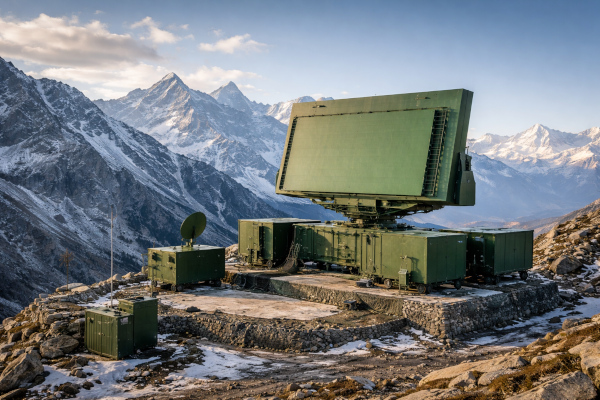
India’s push to deepen self-reliance in defence procurement received another significant lift on March 31, 2026, when the Ministry of Defence signed a capital acquisition contract worth around Rs 1,950 crore with Bharat Electronics Limited for two Mountain Radars, along with associated equipment and required infrastructure, for the Indian Air Force. The agreement was signed in New Delhi under the Buy (Indian–Indigenously Designed, Developed and Manufactured) category, reinforcing the government’s emphasis on Aatmanirbhar Bharat and Make in India in strategically important defence technologies.
The programme is important because mountain radar coverage idirectly addresses the demands of surveillance and air defence in difficult high-altitude terrain, where line-of-sight, mobility, weather, and deployment conditions impose far greater challenges than in the plains. By procuring radars specifically configured for mountain environments, the Indian Air Force is strengthening its ability to maintain situational awareness in complex sectors where early detection and reliable tracking can make a critical difference to operational readiness. This is an inference based on the stated role of the system as a “Mountain Radar” for IAF air defence, though the PIB release itself does not disclose technical specifications or deployment locations.
According to the Ministry of Defence, the radar has been indigenously designed and developed by DRDO’s Electronics & Radar Development Establishment (LRDE) and will be manufactured by BEL, underscoring the mature partnership that now exists between India’s defence R&D establishment and its production agencies. That combination matters: DRDO provides indigenous design depth, while BEL serves as the manufacturing backbone for translating that research into deployable operational systems for the armed forces.
The government has said the installation and commissioning of these radars will boost the country’s air defence and strengthen national security, while also reducing dependence on foreign equipment. In practical terms, such procurements gradually expand India’s control over maintenance, upgrades, lifecycle support, and future adaptation of mission-critical systems—an important strategic advantage at a time when supply-chain resilience and technology sovereignty have become central to defence planning.
It should be noted that it fits into a broader pattern of Indian air-defence modernisation increasingly anchored in homegrown sensors, networks, and weapons. The significance lies in the ecosystem it sustains: domestic design houses, production lines, testing infrastructure, integration capability, and the larger industrial confidence needed to keep more sophisticated indigenous programmes moving forward. In that sense, the Mountain Radar deal is both an operational acquisition and an industrial statement.
For the Indian Air Force, the induction of these systems should help sharpen monitoring and response capability in terrain where air surveillance gaps can carry outsized strategic consequences. For India’s defence industry, the contract is another marker of the growing shift from import dependence toward locally designed and manufactured mission systems. And for the wider national security framework, it signals a continuing effort to ensure that capability enhancement in sensitive environments is increasingly backed by indigenous technology rather than external supply chains.
Reference: PIB.
You may also like
-
India’s Indigenous Sonar Ecosystem Powers New Generation of Indian Navy Warships
-
Murshidabad Becomes First West Bengal District to Complete Land Handover for India-Bangladesh Border Fencing
-
India’s LR-AShM Family Could Reach 3,500 Km as DRDO Develops Extended-Range Hypersonic Variants
-
Indian Composite Manufacturing Gets BrahMos Boost With ₹60-Crore Order to Allen Reinforced Plastics
-
HAL-Samtel Opens New Gurugram Facility to Expand Indigenous Defence Avionics and Display Manufacturing
