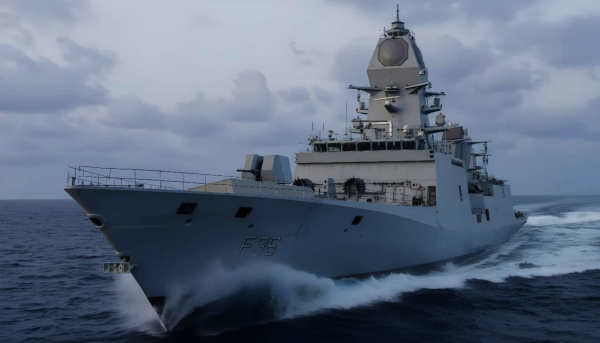
The Indian Navy on March 30, 2026 took delivery of Dunagiri, the fifth warship in the Nilgiri-class (Project 17A) series and the second of the class to be built by Garden Reach Shipbuilders & Engineers Ltd. (GRSE), Kolkata, in another major step for India’s indigenous warship-building programme. More than just another platform entering service, Dunagiri represents the steady maturation of India’s capacity to design, build and deliver complex frontline surface combatants at home, while also underlining the Navy’s continuing push toward Aatmanirbharta in naval construction.
Dunagiri carries both operational and symbolic weight. It revives the legacy of the earlier INS Dunagiri, a Leander-class frigate that served the Indian Navy from May 5, 1977 to October 10, 2010. But while the name returns from an earlier era, the new vessel belongs to a very different generation of warship design. The Project 17A frigates are intended as advanced multi-mission combat platforms built to meet current and future maritime challenges, and they reflect a significant leap over the earlier Shivalik-class (Project 17) in stealth shaping, survivability, automation and combat integration.
Designed by the Indian Navy’s Warship Design Bureau and overseen by the Warship Overseeing Team, Kolkata, the Project 17A programme has become one of the clearest expressions of India’s progress in indigenous naval architecture. Dunagiri, according to the official description, embodies that progress in visible form, combining reduced signature features, higher combat capability and improved survivability with modern construction practices. The Navy has also highlighted that the ship was built under the philosophy of Integrated Construction, helping keep delivery within the envisaged timeline.
From a combat perspective, the class is designed as a potent multi-role frigate with a significantly enhanced weapons and sensor package. The propulsion arrangement follows a Combined Diesel or Gas (CODOG) configuration, using a diesel engine and a gas turbine on each shaft driving Controllable Pitch Propellers, backed by a modern Integrated Platform Management System. The warship’s weapon and sensor suite includes BrahMos surface-to-surface missiles, the MF-STAR radar, the MRSAM air defence complex, a 76 mm Super Rapid Gun Mount, close-in weapon systems using 30 mm and 12.7 mm guns, and anti-submarine warfare armament including rockets and torpedoes. In effect, Dunagiri is built to operate across the full spectrum of frigate missions: anti-surface warfare, anti-air warfare and anti-submarine warfare.
One of the more important industrial signals in the delivery is the improvement in build timelines. Dunagiri is the fifth Project 17A ship delivered to the Navy in the last 16 months, and the programme appears to be gaining construction efficiency as experience accumulates. While the first ship of the class, Nilgiri, took 93 months to build, Dunagiri’s construction period was compressed to 80 months, suggesting that the learning curve in yard processes, modular integration and supply-chain coordination is beginning to show measurable results.
The ship’s delivery also carries wider economic and strategic value beyond naval capability alone. With an indigenisation content of 75 per cent, the project has drawn in more than 200 MSMEs, demonstrating how major defence manufacturing programmes increasingly rest on a broad domestic industrial ecosystem rather than a single yard alone. According to the official figures, the programme has generated employment for around 4,000 personnel directly and over 10,000 indirectly, making it not just a military milestone but also a substantial industrial one.
In strategic terms, Dunagiri’s induction matters because frigates remain among the most flexible assets in a navy’s order of battle. They can escort carrier and amphibious groups, protect sea lines of communication, conduct anti-submarine patrols, provide layered air defence, and project presence across contested maritime spaces. For India, which faces a more competitive security environment in the Indian Ocean and beyond, the ability to induct modern, heavily armed, stealth-oriented frigates from domestic shipyards is a tangible marker of naval preparedness.
The delivery of Dunagiri therefore stands as more than a ceremonial handover. It signals that India’s warship-building ecosystem is not only producing advanced combatants, but is doing so with increasing confidence, higher indigenous content, and growing momentum. In that sense, the ship is both a fighting platform and a statement: that India’s ambition for self-reliance in complex naval construction is no longer an aspiration alone, but an increasingly visible reality.
Source: PIB
You may also like
-
India’s Indigenous Sonar Ecosystem Powers New Generation of Indian Navy Warships
-
Murshidabad Becomes First West Bengal District to Complete Land Handover for India-Bangladesh Border Fencing
-
India’s LR-AShM Family Could Reach 3,500 Km as DRDO Develops Extended-Range Hypersonic Variants
-
Indian Composite Manufacturing Gets BrahMos Boost With ₹60-Crore Order to Allen Reinforced Plastics
-
HAL-Samtel Opens New Gurugram Facility to Expand Indigenous Defence Avionics and Display Manufacturing
