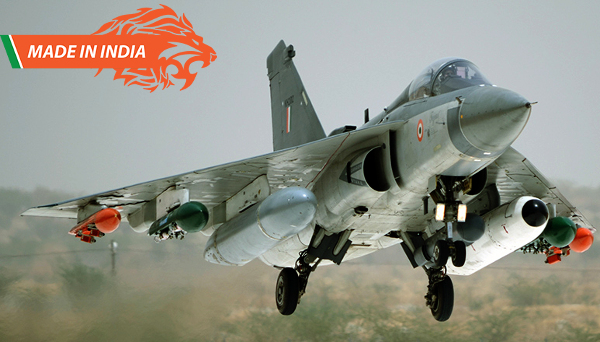
India’s Tejas fighter programme has now moved beyond the older baseline discussion of “an indigenous light fighter” and into a more specific technology-refresh phase, with the most important recent changes centred on the latest LCA Mk1A configuration. The clearest official marker came in September 2025, when the Ministry of Defence signed the contract for 97 additional LCA Mk1A aircraft and explicitly stated that these jets would carry 67 additional items over and above the earlier January 2021 Mk1A contract. That matters because it is the most direct official indication of what has changed most recently in the programme, as opposed to long-standing Tejas features that were already known.
The most significant of those newly highlighted changes is the planned integration of the indigenous UTTAM AESA radar into the latest Mk1A standard. That is not a cosmetic update; it is a major sensor shift. In official terms, the government has now explicitly identified UTTAM as part of the advanced indigenous systems package for the newest Mk1A lot, indicating that the aircraft is moving toward a more sovereign radar architecture rather than remaining defined by earlier imported configurations.
Alongside the radar, the latest Mk1A package also includes the Swayam Raksha Kavach electronic warfare suite, another important technical change that directly affects survivability. In a modern combat aircraft, electronic warfare capability often matters as much as aerodynamic performance, because survivability against hostile radars, missiles, and jamming environments increasingly depends on the aircraft’s onboard defensive electronics. By naming Swayam Raksha Kavach in the 2025 contract, the MoD signalled that the newest Tejas standard is being defined as a more modern indigenous combat-systems stack.
One of the more concrete hardware-level changes is in the aircraft’s control surfaces and flight-control hardware. The 2025 contract specifically cites control surface actuators among the indigenous systems being integrated, and this builds on an earlier milestone from 19 April 2024, when DRDO’s Aeronautical Development Agency handed over the first batch of indigenous Leading Edge Actuators and Airbrake Control Module to HAL for the Tejas Mk1A. Officially, these secondary flight-control elements use servo-valve-based electro-hydraulic servo actuators and control modules, and the government said their flight trials had been completed before production clearance. In practical terms, that means one of the latest real changes to Tejas is deeper indigenisation of its flight-control actuation hardware.
Weapons integration has also advanced in a way that directly matters to the latest Mk1A standard. On 12 March 2025, ADA successfully test-fired the indigenous Astra beyond-visual-range air-to-air missile from an LCA Air Force Mk1 prototype, and the MoD described the test as a “significant milestone” toward induction of the LCA AF Mk1A variant. The ministry also stated that Astra is capable of engaging targets at over 100 km. That makes Astra integration one of the clearest recent combat-capability upgrades tied to the aircraft’s current evolution.
Another major shift is quantitative but still technical in effect: the latest Mk1A batch is officially pegged at over 64% indigenous content. That figure matters because it is linked to the 67 additional items in the 2025 contract, suggesting that the newest Tejas standard is more deeply Indian-built configuration across avionics, mission systems, and aircraft subsystems.
The shape of the programme has also changed operationally. The September 2025 contract covers 68 fighters and 29 twin-seaters, showing that the updated Mk1A line is no longer confined to a narrow single-seat production concept. Instead, the latest standard is being extended into a broader fleet architecture that includes the training and conversion ecosystem inside the same modernised programme.
Industrial capacity has moved in parallel with the new configuration. On 17 October 2025, the Raksha Mantri inaugurated the third Tejas Mk1A production line at HAL’s Nashik facility and flagged off the first Mk1A produced there.This underwrites the manufacturing throughput needed to deliver the updated configuration in meaningful numbers.
Propulsion remains a critical enabling factor, and the most recent official update here came through the MoD’s 2025 year-end review, which stated that HAL entered into an agreement with GE Aerospace on 7 November 2025 for 113 F404-GE-IN20 engines and a support package for the 97-aircraft Mk1A programme, with deliveries slated for 2027 to 2032.
The current Mk1A standard is being defined by the UTTAM AESA radar, the Swayam Raksha Kavach electronic warfare suite, indigenous control-surface actuation hardware, a more mature Astra BVRAAM integration path, and a larger 64%+ indigenous-content baseline supported by 67 additional items beyond the earlier contract. That is the real story of Tejas right now. The programme is no longer just about fielding an indigenous fighter; it is increasingly about fielding an indigenous combat-systems architecture inside a fighter that is still evolving.
Reference:
https://www.pib.gov.in/PressReleasePage.aspx?PRID=2171108
https://www.pib.gov.in/PressReleasePage.aspx?PRID=2111068
https://www.pib.gov.in/PressReleasePage.aspx?PRID=2018282
https://www.pib.gov.in/PressReleasePage.aspx?PRID=2180339
https://www.pib.gov.in/PressReleasePage.aspx?PRID=2210154
You may also like
-
India’s Indigenous Sonar Ecosystem Powers New Generation of Indian Navy Warships
-
Murshidabad Becomes First West Bengal District to Complete Land Handover for India-Bangladesh Border Fencing
-
India’s LR-AShM Family Could Reach 3,500 Km as DRDO Develops Extended-Range Hypersonic Variants
-
Indian Composite Manufacturing Gets BrahMos Boost With ₹60-Crore Order to Allen Reinforced Plastics
-
HAL-Samtel Opens New Gurugram Facility to Expand Indigenous Defence Avionics and Display Manufacturing
