Deendayal Port Authority at Kandla has added a notable new chapter to India’s maritime record by carrying out what port officials and shipping industry reports describe as the country’s first triple-banking ship-to-ship (STS) cargo operation at a strong tidal port. The operation involved three vessels working in a side-by-side transfer configuration — a manoeuvre regarded as among the most demanding in port and offshore cargo handling because it requires precise mooring control, constant vessel alignment, and tight coordination under changing marine conditions.
According to Deendayal Port Authority’s public update, the operation saw a Capesize vessel discharge about 1,17,000 tonnes of cargo to a transshipment vessel, while a simultaneous tandem transfer moved another 77,000 tonnes onto a Panamax vessel. In total, roughly 1,94,000 tonnes of cargo were handled in a single integrated marine exercise. Trade publication reports and ANI’s account of the event say this is the first time such a triple-banking STS operation has been executed at a strong tidal Indian port, underlining both the scale and the technical complexity of the feat.
What makes the achievement especially significant is the operating environment. Ship-to-ship transfers are complex even in calm waters, but tidal conditions sharply raise the difficulty by affecting vessel movement, mooring loads, approach angles, and the stability required for safe cargo transfer. Industry guidance from OCIMF notes that STS operations demand careful assessment of environmental conditions and mooring loads, while marine insurers have also flagged tidal conditions as a key operational risk during STS manoeuvres. In that context, the successful completion of a three-vessel side-by-side cargo transfer at Kandla points to a high level of marine planning, seamanship, and port-side execution.
The milestone also fits into the wider rise of Deendayal Port Authority as one of India’s busiest maritime gateways. Official DPA documents describe the port as one of the biggest and busiest among India’s major ports, located in the Gulf of Kutch, and note that it has held the top position among major ports in cargo handling for many years in the last decade. Ministry data for April 2024 to March 2025 show Deendayal Port handled 150.16 million tonnes of cargo during the year, second only to Paradip’s 150.41 million tonnes among major ports, while handling the highest share of overseas cargo at 20.60 percent. In March 2025 alone, Deendayal handled 16.33 million tonnes, the highest among India’s major ports for that month.
DPA’s own project documents further show the scale and diversity of the port’s marine infrastructure. The port has 16 dry, break-bulk and container berths at Kandla, eight oil jetties, and multiple facilities at Vadinar, including Single Buoy Moorings capable of handling very large crude carriers. Another DPA document says the port crossed the 150-million-tonne mark in FY 2024-25, reinforcing its growing importance as a logistics and bulk cargo hub on India’s west coast.
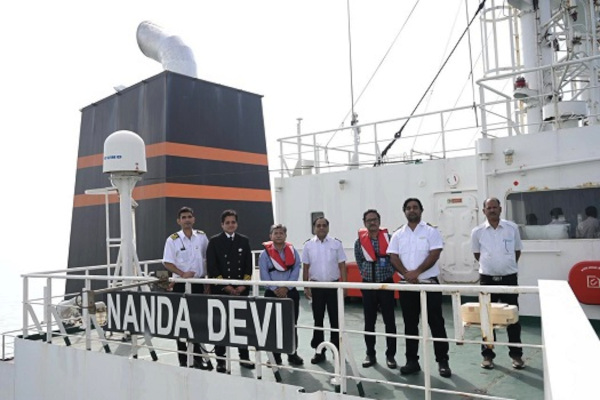
The importance of STS capability has also grown in recent weeks. A PIB release dated March 17, 2026, reported the arrival of MT Nanda Devi near Vadinar carrying 46,500 metric tonnes of LPG for an STS transfer operation managed by Deendayal Port Authority. The release described STS operations as critical for safe and efficient cargo transfer, reducing congestion, saving time and cost, and strengthening supply chain resilience. That official statement did not refer to the later triple-banking feat, but it does show that DPA has been actively handling sophisticated STS operations in the region as part of India’s broader logistics and energy security architecture.
Taken together, the Kandla operation is more than a single port-side success. It signals a maturing maritime ecosystem in which Indian ports are increasingly demonstrating the technical ability to handle high-risk, high-precision cargo movements that were once seen as exceptional. While the “first in India” characterisation presently appears to rest on DPA’s public claim and shipping-industry reporting rather than a separate central government technical certification, the operation itself is undeniably a major marine achievement — both in scale and in execution
Source: PIB
You may also like
-
Tata Power Renewables Commissions 72.5 MW Solar Project in Rajasthan to Support Tata Steel’s Decarbonisation
-
NTPC Targets 244 GW by 2037 With ₹16.86-Lakh-Crore Expansion Across India’s Energy Sector
-
UPI Completes a Decade as Transaction Value Surges More Than 4,000-Fold
-
AGNIT Semiconductors: Building India’s Gallium-Nitride Chip Capability for Radar, Communications and Power Electronics
-
India and Canada Target Comprehensive Trade Agreement by End of 2026
