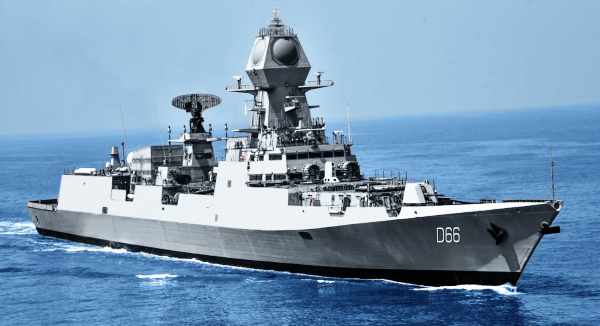
The Indian Navy is taking part in the US-led multinational anti-submarine warfare exercise “Sea Dragon 2026”, currently being conducted at Andersen Air Force Base in Guam. The exercise brings together maritime forces from several partner nations and aims to enhance operational coordination, tactical proficiency, and interoperability among participating navies in the Indo-Pacific region.
Exercise Sea Dragon is an annual multinational maritime exercise hosted by the United States Navy’s 7th Fleet, focusing primarily on advanced anti-submarine warfare (ASW) training. The 2026 edition involves participation from the Indian Navy, the Japan Maritime Self-Defense Force, the Royal Australian Air Force, the Royal New Zealand Air Force, and the United States Navy, reflecting the growing cooperation among Indo-Pacific maritime partners.
The exercise, conducted over a two-week period in March, is designed to strengthen the ability of participating forces to detect, track, and counter submarine threats in complex maritime environments. During the drills, participating crews engage in a series of progressively challenging scenarios ranging from simulated target tracking to the detection and monitoring of live submarines.
India’s participation in the exercise is led by the Indian Navy’s P-8I long-range maritime patrol and reconnaissance aircraft, a key asset used for surveillance, anti-submarine warfare, and maritime domain awareness. The aircraft works alongside similar platforms from partner nations, including the P-8A Poseidon aircraft operated by the United States and Australia, the Kawasaki P-1 of Japan, and other maritime patrol aircraft.
Throughout the exercise, aircrews from the participating countries conduct coordinated missions that test their speed, accuracy, and decision-making abilities while operating in multinational teams. These missions include submarine detection drills, coordinated tracking operations, and tactical planning sessions designed to enhance joint operational effectiveness.
The exercise also includes extensive classroom planning and mission debriefing sessions where aircrews share operational experiences and discuss tactics. Such exchanges allow participating forces to understand each other’s capabilities, improve communication protocols, and develop common operational procedures.
Exercise Sea Dragon has been held annually since 2019 and has gradually expanded in complexity and scale. The drills have evolved into one of the important maritime security exercises in the Indo-Pacific, focusing on strengthening cooperation among like-minded nations committed to maintaining stability and freedom of navigation in the region.
For India, participation in Sea Dragon reflects its expanding role in regional maritime security and its growing defence cooperation with partner nations. The Indian Navy regularly participates in multinational exercises such as Malabar, RIMPAC, and Sea Dragon, which provide valuable opportunities for joint training, technological exchange, and operational coordination with friendly navies.
Such exercises also play a critical role in improving readiness against evolving underwater threats, particularly in strategically important maritime regions. Anti-submarine warfare remains a complex and technologically demanding domain of naval operations, requiring close coordination between aircraft, ships, and underwater sensors.
India’s involvement in Sea Dragon 2026 therefore underscores its commitment to strengthening maritime partnerships and contributing to a free, open, and secure Indo-Pacific region. By working closely with partner nations through joint exercises and coordinated operations, the Indian Navy continues to enhance its operational capabilities and reinforce international cooperation in safeguarding global maritime security.
Source: The Hindu BusinessLine; United States Navy / Defence sources.
You may also like
-
Japanese Parliamentary Delegation Visits BEL and Reviews Advanced Defence Systems
-
India and Sri Lanka Conduct SLINEX-26 Maritime Exercise at Visakhapatnam
-
India and Thailand Move Toward UPI–PromptPay Link and Rupee–Baht Settlement to Deepen Economic Integration
-
India and Russia Deepen Army-to-Army Cooperation as General Dhiraj Seth Visit Russia
-
India and Canada Push to Accelerate CEPA Negotiations as Economic Engagement Gains Momentum
