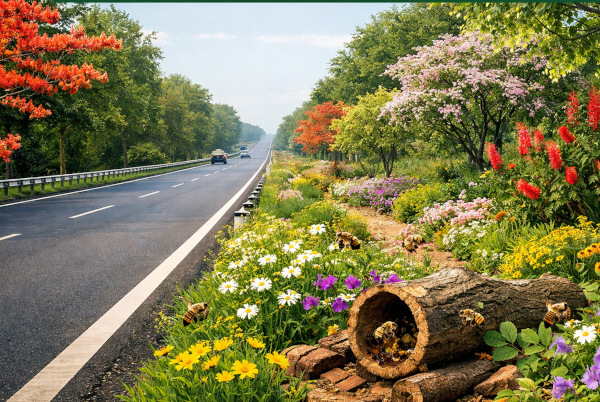
Reaffirming its commitment to sustainable infrastructure development, the National Highways Authority of India (NHAI) has announced a first-of-its-kind initiative to establish pollinator, or ‘Bee Corridors’, along National Highways. The initiative marks a significant transition from conventional ornamental plantations to ecologically driven green infrastructure.
The Bee Corridor concept envisions continuous linear stretches of bee-friendly vegetation comprising flowering trees and plants that provide a steady supply of nectar and pollen throughout the year. National Highway plantations offer a unique opportunity to support pollinator conservation, particularly at a time when honeybees and other pollinating species are facing growing ecological stress. The decline of pollinators has far-reaching consequences, adversely affecting pollination services, agricultural and horticultural productivity, and the broader ecological balance.
Under this initiative, NHAI will align its plantation strategy towards the creation of dedicated pollinator habitats. The corridors will feature a diverse mix of trees, shrubs, herbs, and grasses, retaining wild ecological elements by incorporating nectar- and pollen-rich plant species. The approach will also allow flowering weeds to bloom naturally and retain dead wood and hollow trunks—features that are highly beneficial to pollinators. Careful species selection will ensure flowering across seasons, enabling near-continuous blooming throughout the year.
The plantation plan prioritizes native tree and plant species such as Neem, Karanj, Mahua, Palash, Bottle Brush, Jamun, and Siris, which are well-suited to local ecosystems and provide high value to pollinators.
Based on agro-climatic conditions and regional suitability, Bee Corridors will be developed along selected National Highway stretches as well as on vacant NHAI land parcels. Field offices across the country will identify highway sections where clusters of flowering trees can be planted at intervals of approximately 500 metres to one kilometre—aligned with the average foraging range of honeybees and wild bees. During 2026–27, each NHAI field office will plan and develop at least three pollinator corridors.
As part of its broader green development agenda, NHAI aims to plant approximately 40 lakh trees along National Highways during 2026–27, with nearly 60 percent of these plantations falling under the Bee Corridor initiative.
This pioneering effort is expected to significantly enhance ecological outcomes, strengthen pollinator conservation, and further reinforce NHAI’s commitment to environmentally responsible and sustainable National Highway development.
You may also like
-
India Ranks First Among 41 Markets in Swedish Global Business Climate Survey 2026
-
India’s Semiconductor Market Could Cross US$200 Billion by 2035 as Domestic Demand Accelerates
-
Pace Robotics Moves Construction Automation From Pilot Stage to Commercial Deployment
-
Hindustan Shipyard Docks Three Vessels Simultaneously in Precision Engineering Milestone
-
BCCL Dispatches First Rake From 5-MTPA Maheshpur Rapid Loading System
