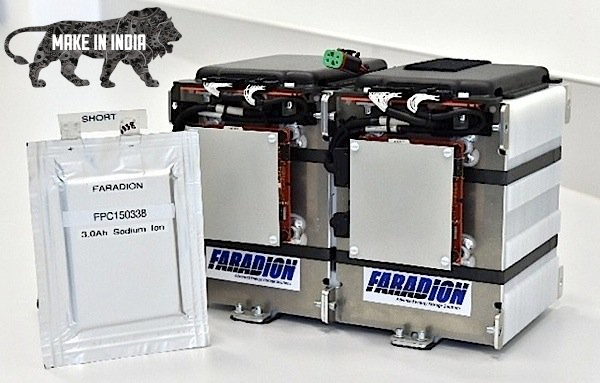
Faradion Ltd., a manufacturer of sodium-ion cells based in the UK, has said that it has begun exploring manufacturing presence in India. The manufacturer says that sodium-ion technology provides similar performance to conventional chemistries while replacing expensive materials such as cobalt and lithium with sodium. Faradion has bagged its first order from ICM Australia and suggests that sodium-ion battery technology with its superiority over lithium-ion batteries can revolutionise the automobile/mobility, storage and mobile sectors across the world.
Unlike lithium-ion batteries, Faradion’s sodium-ion batteries have enhanced thermal stability and safety. Further, they can be safely transported and maintained at zero volts. It would also be a more cost-effective alternative as sodium-ion technology replaces expensive materials with far more abundant sodium.
“We foresee India as our next priority big market, given the electric mobility market waiting to grow rapidly” – James Quinn, CEO of Faradion
Since India is one of the largest markets for mobile devices across the world and also demonstrated significant progress in the adoption of EV (Electric Vehicle) technology, Faradion sees the country as a priority market.
Furthermore, as the world seeks out alternatives to China-dependent Lithium-ion batteries, Faradion’s Sodium-ion based technology could offer a promising solution. In line with this, Faradion is actively exploring manufacturing presence in India for its sodium-ion batteries for diversified applications.
Also read: 1000 km range with this electric car battery! Log9 Materials bets on aluminium fuel cells
Having seen significant interest in regions such as the US, Europe and India due to its performance, safety and price point, James Quinn, CEO of Faradion says Australasia is the next logical region for Faradion given the market conditions.
“Faradion is accelerating large scale industrialisation of its safe, low cost, Sodium-ion energy storage technology. After Australia, we foresee India as our next priority big market, given the huge growth in mobile devices and a bigger electric mobility market waiting to grow rapidly.”
Source: First Post
Image Courtesy: EDI Weekly
You may also like
-
When Trade Routes Become Weapons: Why BRICS Needs a Resilient Supply-Chain Architecture
-
India’s Trade With BRICS More Than Doubles to $417 Billion as Export Opportunity Expands
-
India and Uruguay Agree Trade and Connectivity Roadmap as Montevideo Ratifies International Solar Alliance
-
The Return of Multipolarity: Why the World Is Moving Beyond a Single Centre of Power
-
The Financial Chokepoint: Why BRICS Can No Longer Depend on SWIFT and the Dollar Alone
