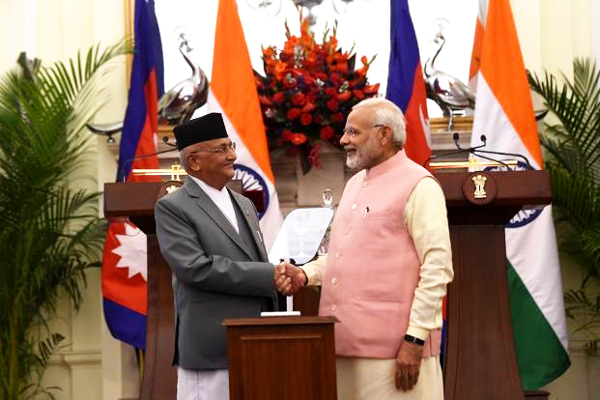
KATHMANDU (NEPAL): The Indian government on Tuesday handed over newly-built school buildings of two educational institutions in the Syangja district of central Nepal.
Buildings of Tribhuvan Adarsha Multiple Campus and Shree Bhupu Sainik Community Academy was handed over to the Nepali government, an official release said.
The institutions also provide Bachelor in Humanities, Education and Management as well as a Masters Degree programme in Management and Education.
The campus has over 400 students with 80 per cent of them being girls.
“The new campus building constructed with the Indian government’s grant assistance of 44.10 million Nepalese Rupees, is a two-storied campus building comprising of 20 classrooms, library room, office room hall, computer lab, compound wall, furniture and separate sanitation facilities for boys and girls on each floor,” the release said.
Meanwhile, the Shree Bhupu Sainik Academy provides education from nursery to Class 12th. The school has over 690 students, about 47 per cent of whom are girls.
“The new school building constructed with Indian government’s grant assistance of 41.90 million Nepalese Rupees, is a double storied school building comprising of a pre-primary block, academy block having 36 rooms, compound wall, furniture and computers and separate sanitation facilities for boys and girls on each floor,” the release said.
“The Indian government is happy to be associated with the project which compliments effort of Government of Nepal in augmenting infrastructure in the field of education,” it added.
Source: ANI
Image Courtesy: :LiveMint
You may also like
-
India and Italy Hold First Maritime Security Dialogue in Rome, Strengthen Strategic Maritime Cooperation
-
India and Azerbaijan Agree to Strengthen Security, Trade, Energy and Economic Cooperation
-
Jaishankar Meets Azerbaijan President Ilham Aliyev in Baku, Discusses Trade, Technology and Strategic Cooperation
-
Piyush Goyal Holds High-Level Talks in Berlin to Strengthen India–Germany Trade, Investment and Industrial Cooperation
-
Indian Navy to Host Indo-Pacific Regional Dialogue 2026 with Experts from 18 Countries on Maritime Science and Technology
