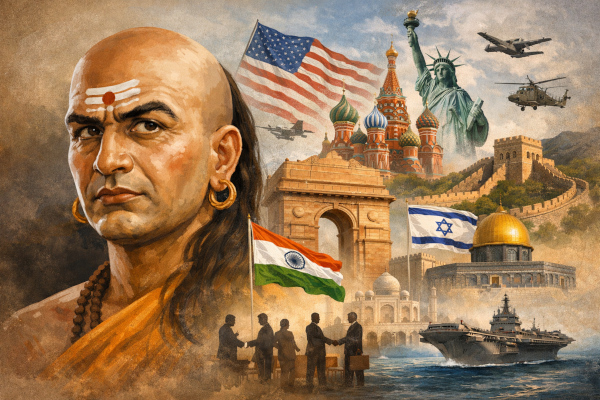
“अतिरूपेण वा सीता अतिगर्वेण रावणः ।
अतिदानाद्बलिर्बद्धो ह्यतिसर्वत्र वर्जयेत्॥”
Atirūpeṇa vā Sītā, atigarveṇa Rāvaṇaḥ|
Atidānād Balir baddho hy atisarvatra varjayet.|| 03-12
Sita suffered because of her extraordinary beauty, Ravana was destroyed because of his excessive pride, and King Bali was bound because of his excessive generosity; therefore, excess should be avoided everywhere.
This ancient counsel from Chanakya Niti reverberates profoundly in India’s contemporary diplomacy. In an era of intensifying great-power competition, India has pursued strategic autonomy — a calibrated engagement with all major powers without being overly dependent on any single one. By avoiding extremes in alignment, India is applying the wisdom of “ह्यतिसर्वत्र वर्जयेत्” in global geopolitics, ensuring its sovereignty and national interest remain paramount.
India’s relationship with Russia is rooted in decades of strategic cooperation. During the Cold War, Moscow became India’s chief defense supplier; by the 1980s, around 70–75 percent of Indian military equipment was sourced from the Soviet Union. Even after the Soviet collapse, this partnership endured. As recently as 2024–25, bilateral trade reached a record US $68.7 billion, driven heavily by energy imports and defense cooperation. India’s defense procurements from Russia remain substantial, with platforms such as the Su-30 fighter jets, T-90 tanks, and S-400 air defense systems forming a core part of its arsenal. Yet India has moderated this dependence in recent years, diversifying sources while preserving historical ties — a clear effort to avoid overdependence.
At the same time, India’s engagement with the United States has rapidly expanded. Bilateral trade between India and the U.S. has topped US $190 billion, making the United States one of India’s largest trading partners. Beyond commerce, strategic cooperation has deepened through frameworks like the Quad (with Japan and Australia), joint military exercises (including the Malabar naval exercises), and coordination on Indo-Pacific security. Technology, semiconductor supply chains, clean energy, and space cooperation further diversify the partnership. This expanding relationship underscores India’s recognition that exclusive alignment with one bloc — as Chanakya cautioned — would risk strategic constriction.
India’s diplomacy also reflects balance with Western partners beyond the U.S.. With the European Union, India has engaged on shared challenges like climate change and economic recovery, while trade with the EU bloc exceeded US $125 billion in recent years. With United Kingdom, India has negotiated initiatives on defense, education, and counter-terrorism cooperation, balancing historical ties with present-day interests.
At the same time, India has sustained robust ties with Israel, especially in defense and technology. Since establishing full diplomatic relations in 1992, defense cooperation has grown, with India becoming one of Israel’s largest arms customers. Collaborations in cybersecurity, agriculture technology, and intelligence sharing bolster India’s security architecture. Yet India refrains from entangling itself in Middle Eastern bloc politics, maintaining an independent posture that refuses to be hostage to factional alignments — again reflecting Chanakya’s admonition against excessive attachment.
In Asia, this balance becomes even more evident. India’s ties with China are complex: economic engagement continues despite strategic competition along the Line of Actual Control (LAC). China remains a top trade partner, with bilateral trade surpassing US $135 billion in 2023-24, yet India has taken a cautious stance after the 2020 border clashes, enhancing infrastructure and force posture along the frontier. India’s approach towards China is neither confrontation nor complacency; it is a calibrated mix of economic interaction and defensive preparedness — a fine example of avoiding extremes in diplomacy.
In South Asia, India’s neighborhood policy reflects similar balance. With Bangladesh, India has fostered cooperation in connectivity, energy, and trade; with Sri Lanka, it engages on infrastructure and security despite competing Chinese influence. Relations with Nepal and Bhutan emphasize respect for sovereignty while strengthening cultural and economic ties. These neighborhood relationships underscore India’s effort to avoid hegemonic overreach — another form of excess Chanakya warns against.
Even in global institutions like the United Nations, India has pursued a dual track: advocating reform (including a permanent UNSC seat) while maintaining principled stances on peace, development, and humanitarian issues. During votes on the Ukraine conflict, India’s consistent choice to abstain or not fully condemn Russia reflected its calculation to preserve diplomatic space without alienating the West. Such choices draw scrutiny, but they allow India to engage with all stakeholders, uphold its interests, and avoid the rigidity of bloc politics.
History offers sobering counterexamples of nations that ignored this principle of balance. Ukraine, in the years preceding the 2022 war, increasingly anchored its security orientation toward Western institutions without possessing sufficient deterrent capacity or strategic insulation from Russia. The resulting conflict devastated its economy, displaced millions, and left its survival heavily dependent on external military and financial support. The tragedy illustrates the peril of imbalance in great-power rivalry.
Similarly, Iraq under Saddam Hussein exemplified the consequences of excessive pride. After receiving considerable backing during the Iran–Iraq War, Baghdad miscalculated international tolerance and invaded Kuwait in 1990. The outcome was catastrophic: war, sanctions, economic collapse, and eventual regime change. Hubris and overestimation — “अतिगर्व” in Chanakyan terms — proved fatal.
Even closer to home, Pakistan demonstrated the risks of strategic overdependence. During the Cold War and later the War on Terror, Islamabad aligned heavily with Washington for military and financial assistance. While short-term gains followed, structural economic resilience did not. When geopolitical priorities shifted, Pakistan faced economic strain, debt vulnerabilities, and diplomatic isolation — illustrating how excessive reliance can erode autonomy.
India’s calibrated foreign policy today stands in contrast to historical cases where excessive alignment or overconfidence led to downfall — exactly the caution Chanakya articulated. By refusing to anchor its destiny wholly to any single power, India mirrors the ancient strategist’s insistence that virtues, when taken too far, can become vulnerabilities. In avoiding excessive pride, excessive loyalty, or excessive dependency, India asserts its sovereignty while remaining an active, constructive participant on the world stage.
Chanakya’s wisdom — distilled into the crisp admonition to avoid extremes — resonates not merely as philosophical guidance but as practical statecraft. In an age defined by shifting alliances, great-power rivalry, economic interdependence, and security challenges, India’s balanced diplomacy reflects a commitment to autonomy, adaptability, and strategic foresight. By navigating the complexities of relations with the U.S., Russia, China, Israel, and others without succumbing to rigid alignments, India demonstrates that balance, not excess, is the key to enduring influence in global affairs.
You may also like
-
India–Finland Ties Enter New Phase as President Alexander Stubb Concludes State Visit to India
-
India Drives AI Integration in Education to Build Talent Pipeline for Global Leadership
-
India–Canada Ties Get Strategic Push as Prime Minister’s Visit Yields Major Agreements Across Trade, Energy and Technology
-
INS Sudarshini Reaches Alexandria After Landmark Suez Canal Transit
-
Global Dance Overture Brings Indo–Russian Cultural Harmony to Kamani Theatre
