अयममृतनिधानं नायकोऽप्योषधीनां
अमृतमयशरीरः कान्तियुक्तोऽपि चन्द्रः ।
भवति विगतरश्मिर्मण्डलं प्राप्य भानोः
परसदननिविष्टः को लघुत्वं न याति ॥ ०३-३१
ayam amṛta-nidhānaṁ nāyako’py oṣadhīnām
amṛtamaya-śarīraḥ kānti-yukto’pi candraḥ |
bhavati vigata-raśmir maṇḍalaṁ prāpya bhānoḥ
para-sadana-niviṣṭaḥ ko laghutvaṁ na yāti ||03-22
The moon is the repository of nectar, the lord of medicinal herbs, and its body is full of soothing brilliance. Yet when it enters the sphere of the sun, it loses its rays. Who does not become diminished when living in another’s domain?”
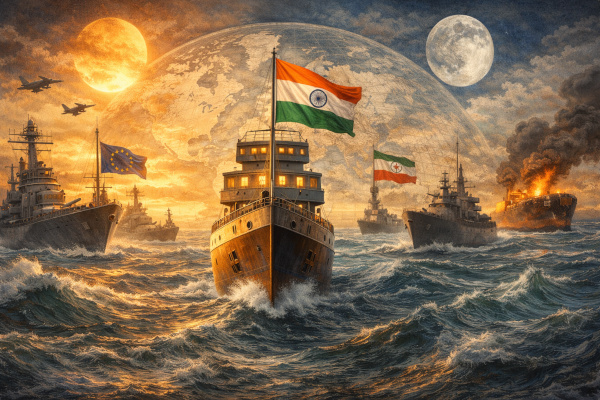
In the political wisdom of Chanakya Niti, one verse offers an enduring lesson on the nature of power and independence. The ancient strategist Chanakya writes that the moon—described as a repository of nectar and the lord of medicinal herbs—loses its visible brilliance when it enters the sphere of the sun. The metaphor concludes with a pointed question: who does not become diminished when living in another’s house? The message is unmistakable. Even a naturally radiant entity can appear insignificant when it operates under the overwhelming dominance of another power. Independence, therefore, is not merely a matter of pride; it is a condition necessary for preserving influence and dignity.
This ancient insight resonates powerfully in the context of modern geopolitics. The twenty-first century international system is increasingly shaped by intense rivalries among major powers. Nations across the world are being pulled toward competing geopolitical blocs centered around the United States, China, Russia, and the European Union. In such an environment, many countries face pressure to align decisively with one camp or another. Alignment can offer short-term security or economic advantages, but it also carries the risk that Chanakya warned about centuries ago: when a state enters entirely into the orbit of a stronger power, its own strategic autonomy may gradually fade.
India has consciously attempted to avoid that fate. Over the past several decades, New Delhi has pursued a foreign policy doctrine widely described as strategic autonomy. Rather than binding itself permanently to any single geopolitical bloc, India seeks to maintain productive relationships across multiple centers of power while preserving its freedom of decision-making. This approach represents a modern expression of Chanakyan statecraft: engage with all, depend on none.
The effectiveness of this strategy became particularly visible during the recent escalation of tensions in West Asia involving Iran and other regional actors. The Strait of Hormuz is one of the most critical arteries of the global energy system. Approximately 20 percent of the world’s petroleum consumption passes through this narrow waterway, making it one of the most strategically important maritime chokepoints on earth. For India, which imports more than 85 percent of its crude oil requirements, the uninterrupted flow of energy through this route is essential for economic stability.
During the crisis, rising tensions raised fears that shipping through the strait could be disrupted or even halted. Such a scenario would have triggered severe global energy shocks. Yet even amid escalating hostilities, Indian vessels were able to continue navigating the passage. Diplomatic engagement with regional actors allowed India to secure safe transit for ships carrying critical cargo, including liquefied petroleum gas shipments exceeding 90,000 metric tons in some cases. This outcome reflected not merely operational logistics but the result of carefully cultivated diplomatic relationships across the region.
India’s ability to maintain communication with all parties involved stems from its longstanding policy of balanced engagement in West Asia. New Delhi has steadily deepened strategic cooperation with Israel and the United States in areas such as defense technology, intelligence sharing, and innovation. At the same time, it has preserved energy and connectivity ties with Iran, including investments in the strategically significant Chabahar port, which provides India with access to Afghanistan and Central Asia while bypassing Pakistan. Simultaneously, India has expanded economic and diaspora connections with Gulf states such as Saudi Arabia and the United Arab Emirates. The Gulf region alone accounts for more than 9 million Indian expatriates, whose remittances contribute billions of dollars annually to India’s economy.
This intricate web of relationships allows India to operate diplomatically across divides that often constrain other states. While rival powers compete for influence in the region, India maintains a reputation as a pragmatic actor capable of engaging with multiple sides simultaneously. In Chanakya’s metaphor, India attempts to remain a moon that shines in its own orbit rather than disappearing entirely within the glare of another sun.
India’s diplomatic flexibility is also visible in its economic strategy, particularly in the realm of trade agreements. While maintaining historical defense and energy ties with Russia, India has simultaneously deepened economic engagement with Western economies. Negotiations toward a comprehensive trade agreement between India and the European Union have gained momentum in recent years. Bilateral trade between India and the EU already exceeds €120 billion annually, making the European bloc one of India’s largest trading partners.
The proposed India–EU Free Trade Agreement aims to expand this relationship by reducing tariffs, improving market access, and facilitating investment flows. For India, such an agreement carries significant strategic value. By strengthening economic integration with Europe, India diversifies its global partnerships and reduces excessive dependence on any single geopolitical partner. At the same time, it allows India to maintain energy and defense cooperation with Russia, demonstrating that economic engagement with Europe does not require abandoning other relationships.
This balancing act illustrates the subtle logic of strategic autonomy. Instead of treating partnerships as mutually exclusive alliances, India treats them as complementary networks of cooperation. Trade with Europe strengthens economic growth and technology access. Defense cooperation with the United States enhances military capability. Energy ties with Russia and the Gulf ensure stability in fuel supplies. Connectivity projects with Iran expand access to Central Asian markets. Each relationship contributes to India’s national interests without subordinating them entirely to the priorities of another power.
The result is a diplomatic architecture built on flexibility rather than rigid alignment. In a world where geopolitical blocs are increasingly confrontational, this approach allows India to retain room for maneuver. When crises emerge, such as the tensions around the Strait of Hormuz, India possesses the diplomatic channels necessary to negotiate solutions without being trapped by alliance commitments.
This strategy also reflects a broader transformation in India’s global role. With a population exceeding 1.4 billion people, the world’s fastest-growing major economy, and a rapidly expanding technological and industrial base, India increasingly operates not as a peripheral state but as a central actor in global affairs. Strategic autonomy enables it to shape outcomes rather than simply react to them.
From a realpolitik perspective, this approach represents a form of quiet advantage. Many countries that align rigidly with one geopolitical bloc find their policies constrained by the priorities of larger powers. They may gain security guarantees or economic benefits, but they also risk becoming instruments of someone else’s strategy. India’s approach seeks to avoid this condition by preserving independent decision-making.
Chanakya’s ancient metaphor captures this dynamic with remarkable clarity. The moon possesses its own beauty and influence, but when it stands too close to the sun its radiance disappears. The lesson is not that cooperation with powerful forces should be avoided. Rather, it is that independence must be preserved within cooperation.
India’s diplomatic conduct in recent years illustrates precisely this principle. By maintaining relationships with diverse powers, expanding economic partnerships such as the EU trade negotiations, and preserving engagement across geopolitical divides, India ensures that it does not disappear within the orbit of any single global power.
In a turbulent international system, where great-power rivalry often forces nations into difficult choices, India’s strategy offers an alternative path. It demonstrates that autonomy, balance, and flexibility can allow a state to navigate crises while safeguarding its interests.
In the end, the wisdom of Chanakya remains strikingly relevant. Nations, like celestial bodies, shine most clearly when they retain their own sphere of influence. By carefully preserving its strategic independence while engaging widely with the world, India continues to embody the ancient lesson: a power that refuses to live permanently in another’s house never loses its light.
You may also like
-
Chanakya Niti – Chapter 3
-
India Advances Semiconductor Talent Development Under Chips to Startups Programme
-
India’s Strategic Rise Through Free Trade Agreements: Achievements and Impact (2025–26)
-
India–Finland Ties Enter New Phase as President Alexander Stubb Concludes State Visit to India
-
India Drives AI Integration in Education to Build Talent Pipeline for Global Leadership
