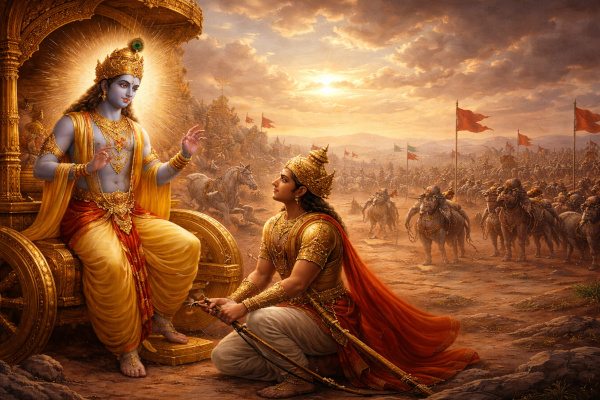
Leadership literature today speaks of emotional intelligence, purpose-driven action, resilience, and ethical clarity. Yet centuries before modern management theory emerged, the Bhagavad Gita articulated a profound philosophy of leadership on the battlefield of Kurukshetra. In the dialogue between Krishna and Arjuna, we witness not merely spiritual instruction, but the transformation of a hesitant warrior into a decisive leader.
The Gita does not offer leadership tactics; it offers leadership consciousness.
1. Clarity of Duty: The Foundation of Leadership
Arjuna’s crisis begins with confusion about his role. He sees teachers, elders, and relatives on the opposing side and questions whether victory is worth the moral cost. His hesitation is deeply human — but Krishna reminds him that leadership collapses when duty is abandoned.
“Swadharme nidhanam shreyah, paradharmo bhayavahah.” (3.35)
Better to perish in one’s own duty than to follow another’s path, which brings fear.
Krishna’s message is not rigid fatalism; it is clarity. Every leader occupies a defined space of responsibility. A judge must judge. A soldier must protect. A leader must decide.
When leaders attempt to escape difficult responsibilities — seeking comfort over conviction — institutions weaken. The Gita insists that leadership demands moral courage: to act according to one’s rightful role, even when it is painful.
Clarity of duty eliminates paralysis.
2. Action Without Attachment: The Discipline of Focus
Modern leaders are often trapped by results — quarterly earnings, public approval, electoral outcomes. Anxiety about the future distorts present performance.
Krishna offers one of the most quoted principles in leadership philosophy:
“Karmanye vadhikaraste ma phaleshu kadachana.” (2.47)
You have the right to action alone, not to the fruits thereof.
This teaching is frequently misunderstood. It does not discourage ambition or excellence. Instead, it sharpens focus. A leader who is obsessed with outcomes becomes reactive and fearful. A leader focused on action becomes steady and disciplined.
Detachment from results cultivates resilience. Success does not inflate the ego; failure does not crush the spirit. Such composure allows long-term vision over short-term emotional swings.
The Gita reframes leadership performance: excellence lies in process integrity, not outcome anxiety.
3. Emotional Mastery: Leadership of the Self
Arjuna’s breakdown illustrates how quickly intelligence collapses under emotional strain. Krishna explains the chain reaction of uncontrolled emotion:
“From attachment arises desire; from desire, anger; from anger comes delusion; from delusion, loss of memory; from loss of memory, destruction of intelligence.” (2.62–63)
This is psychological insight centuries ahead of its time. Leaders often fail not because of lack of knowledge, but because of unmanaged emotion — anger leading to rash decisions, attachment leading to bias, fear leading to avoidance.
Krishna proposes equanimity:
“Samatvam yoga uchyate.” (2.48)
Equanimity is Yoga.
Emotional balance does not mean indifference. It means steadiness under pressure. A leader grounded in equanimity becomes a stabilising force during crises.
In turbulent times, composure is authority.
4. Leading by Example: Influence Over Instruction
Krishna reminds Arjuna that leadership is visible action:
“Yad yad acharati shreshthas tat tad evetaro janah.” (3.21)
Whatever a great person does, others follow.
Leadership is contagious. Behaviour sets culture.
A leader who cuts corners creates a culture of shortcuts. A leader who practices discipline creates disciplined systems. Ethical integrity cannot be outsourced; it must be embodied.
Krishna himself exemplifies this principle. Though he claims nothing remains unattained for him, he continues to act — demonstrating that leadership is responsibility, not privilege.
Influence arises from example, not rhetoric.
5. Vision Beyond Ego: The Instrument of a Greater Purpose
The most dramatic moment in the Gita occurs when Krishna reveals his cosmic form. Arjuna witnesses creation and destruction unfolding within the vastness of time.
Krishna declares:
“Kalosmi loka-kshaya-krit pravriddho.” (11.32)
I am Time, the destroyer of worlds.
The revelation humbles Arjuna. He realises he is not the ultimate architect of events. He is an instrument within a larger design.
Krishna instructs:
“Nimitta matram bhava savya-sachin.” (11.33)
Become merely an instrument, O Arjuna.
Ego-driven leadership seeks control and credit. Instrumental leadership seeks service and alignment with a higher principle — whether justice, nation, organisation, or moral law.
When ego dissolves, clarity strengthens. The leader acts not for personal glory, but for collective good.
6. Transformation: From Doubt to Decision
At the end of the dialogue, Arjuna speaks words that define true leadership awakening:
“Nashto mohah smritir labdha… karishye vachanam tava.” (18.73)
My delusion is destroyed. I have regained clarity. I will act.
The battlefield has not changed. The stakes remain immense. But Arjuna has transformed internally.
Leadership, the Gita suggests, is not about eliminating uncertainty. It is about achieving inner steadiness amidst uncertainty.
Closing Reflection: The Battlefield Within
The Bhagavad Gita endures because Kurukshetra is not merely a geographical field — it is the psychological field within every leader. Decisions that affect families, organisations, and nations often arise in moments of moral tension and emotional turbulence.
Krishna’s counsel remains strikingly relevant: know your duty, act with discipline, master your emotions, lead by example, and surrender ego to a higher purpose. When leaders cultivate clarity instead of panic, purpose instead of pride, and service instead of self-interest, they transform not only outcomes but cultures.
In the end, the Gita teaches that the greatest battlefield is within the human mind — and the greatest victory of leadership is mastery over one’s own fear, attachment, and doubt. Only then can one rise, like Arjuna, steady in conviction and ready to act.
You may also like
-
Steadfast in the Storm: The Wisdom of Patience in the Bhagavad Gita
-
Fear, Duty, and Courage: Real-World Lessons from the Bhagavad Gita
-
PM Launches the Kindle Version of Swami Chidbhavanandaji’s Bhagavad Gita
-
PM Releases Manuscript with Commentaries by 21 Scholars on Shlokas of Srimad Bhagavadgita
-
Gita, A Military Manual, Should Be Read By All, Says Maj Gen Sharan
