
A team of scientists has uncovered how heat flows through magnetic semiconductors, resolving a long-standing puzzle in condensed matter physics and opening new possibilities for designing high-performance electronic and quantum devices.
The breakthrough study, led by Bivas Saha at the Jawaharlal Nehru Centre for Advanced Scientific Research (JNCASR), provides the first direct experimental evidence explaining an unusual thermal behaviour observed in certain magnetic materials. The findings were recently published in the scientific journal Science Advances.
A Decade-Old Scientific Mystery
In most conventional semiconductors, heat conductivity decreases as temperature rises. This happens because higher temperatures cause stronger scattering of phonons—the microscopic vibrations in a material’s lattice structure that carry heat.
However, several magnetic semiconductors have puzzled scientists for years by behaving in the opposite way. Instead of losing heat conduction efficiency, they exhibit increasing thermal conductivity at higher teFig: (Upper Panel) Evolution of dynamic spin-phonon coupling with temperature and its influence on acoustic phonon lifetime. (A) Schematic of coupled spin and phononfluctuations near TN in paramagnetic CrN. At higher temperatures (T >> TN), spin fluctuations and spin-phononcoupling strength diminish. (Lower Panel) Temperature-dependent inelastic X-ray scattering spectrum at q = (0 0 0.18) of CrN highlighting the transverse acoustic (TA) phonon mode. Voigt function–fitted TA phonon mode of CrN at 300K and 373K are presented.Cutting-Edge Experimental Techniquesmperatures, particularly above their magnetic transition point.
One such material is Chromium Nitride (CrN), widely used in protective coatings and electronic applications. Until now, the underlying mechanism responsible for this unusual thermal behaviour remained unclear.
Understanding the Role of Spin and Phonons
The research team discovered that the answer lies in the interaction between phonons and magnetic spin fluctuations within the material.
Magnetic semiconductors contain electron spins that generate magnetic ordering. When temperature rises, this magnetic order weakens, producing dynamic fluctuations in the spins.
The scientists found that these spin fluctuations interact strongly with phonons, influencing how heat moves through the material. Near the material’s magnetic transition point—known as the Néel temperature—phonons experience strong damping due to intense interactions with these fluctuating spins.
Unexpectedly, as temperatures increase further and the magnetic order breaks down, the intensity of spin fluctuations decreases. This allows phonons to travel more freely, increasing their lifetime and enhancing heat conduction.
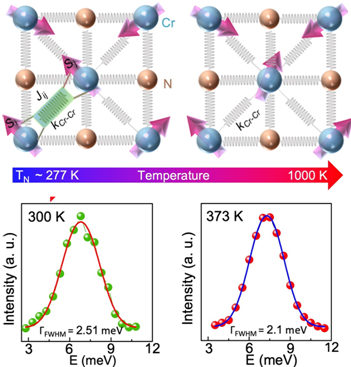
Fig: (Upper Panel) Evolution of dynamic spin-phonon coupling with temperature and its influence on acoustic phonon lifetime. (A) Schematic of coupled spin and phononfluctuations near TN in paramagnetic CrN. At higher temperatures (T >> TN), spin fluctuations and spin-phononcoupling strength diminish. (Lower Panel) Temperature-dependent inelastic X-ray scattering spectrum at q = (0 0 0.18) of CrN highlighting the transverse acoustic (TA) phonon mode. Voigt function–fitted TA phonon mode of CrN at 300K and 373K are presented.Cutting-Edge Experimental Techniques
To observe this phenomenon directly, researchers used advanced temperature-dependent inelastic X-ray scattering techniques to measure phonon lifetimes in high-quality chromium nitride thin films.
These experiments allowed scientists to track the interaction between lattice vibrations and magnetic excitations as the material transitioned from a magnetically ordered state to a disordered one.
The study showed that acoustic phonons—the main carriers of heat—behave very differently from optical phonons in this environment. While optical phonons followed conventional temperature behaviour, acoustic phonons exhibited unusual changes linked to magnetic spin fluctuations.
The experimental observations were further validated through atomistic spin-dynamics simulations and first-principles calculations, which confirmed the microscopic mechanism behind the anomalous heat transport.
Implications for Future Technologies
Understanding how heat flows in magnetic semiconductors has major implications for emerging technologies such as spintronics, magnetic memory systems, and quantum computing devices.
Efficient thermal management is critical for these systems because excessive heat can reduce performance and shorten device lifespans.
According to Prof. Saha, the findings reveal a new strategy for controlling heat flow in advanced materials by manipulating spin–lattice interactions.
By tuning these magnetic properties, scientists may be able to design materials that manage heat more effectively, enabling faster, more energy-efficient electronic and quantum devices.
Global Scientific Collaboration
The research was conducted through a collaboration involving several institutions, including Indian Institute of Science Education and Research Thiruvananthapuram and Linköping University.
Experiments were carried out at major international synchrotron facilities such as SPring-8 and DESY, which provide powerful X-ray sources for studying atomic-scale phenomena.
A Step Forward in Materials Science
The discovery provides a comprehensive framework for understanding thermal transport in magnetically ordered materials and highlights India’s growing contribution to cutting-edge research in condensed matter physics.
By solving the long-standing mystery of heat transport in magnetic semiconductors, the study opens the door to next-generation materials capable of handling the intense thermal demands of future electronic, magnetic, and quantum technologies.
Publication link: 10.1126/sciadv.adw7332
Reference: PIB
You may also like
-
India Moves Toward Satellite Life-Extension Technology with Support for OrbitAID
-
Two New Chicks Mark Milestone in Great Indian Bustard Conservation Programme
-
India’s AI-Driven Telecom Security Platform ‘FraudPro’ Among Global Finalists at Mobile World Congress 2026
-
New Quasi-2D Tellurium Nanosheets Show Promise for Future Clean-Energy Technologies
-
Indian Scientists Rewrite a 50-Year-Old Rule of Bacterial Gene Regulation
