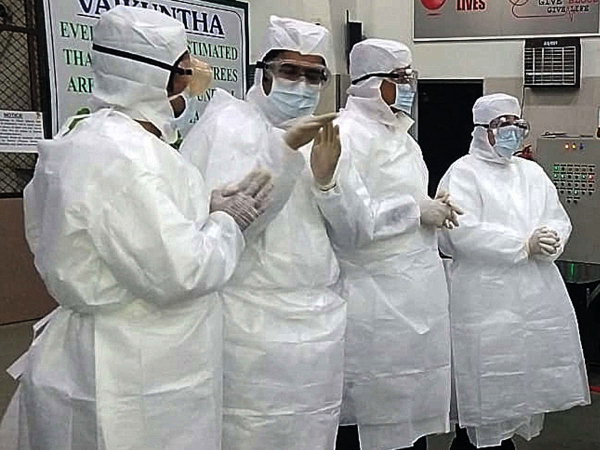
Researchers from the Council of Scientific and Industrial Research (CSIR)’s Pune-based National Chemical Laboratory (CSIR-NCL), Reliance Industries Ltd (RIL), and several other companies from Pune have pooled their expertise to manufacture moulded plastic components from COVID-19 PPE waste.
The project, which is presently on a pilot scale, has been found to have the potential to be scaled up and replicated throughout the country to convert PPE waste into useful and safe products.
The pilot project is aided by Reliance Industries and CSIR-Indian Institute of Petroleum (CSIR-IIP) Dehradun, with funding from the CSIR. It mainly involved converting the decontaminated PPE waste (mainly comprising PPE suits/overalls) into an easily processable and upcycled agglomerated form (pellets or granules).
Researchers from the Council of Scientific and Industrial Research (CSIR)’s Pune-based National Chemical Laboratory (CSIR-NCL), Reliance Industries Ltd (RIL), and several other companies from Pune have pooled their expertise to manufacture moulded plastic components from COVID-19 PPE waste.
The waste PPE kits were collected and decontaminated by Passco Environmental Solutions, a waste management company located in Pune. CSIR-NCL has secured all regulatory approvals needed from Maharashtra Pollution Control Board (MPCB) to complete the pilot trial.
The scientists ensured that the polymer pellets show the right attributes necessary for successful conversion to produce non-food applications, including high-performance automotive components.
In a proof-of-concept study, a team from CSIR-NCL has also successfully demonstrated the lab-scale manufacture of moulded automotive products from the decontaminated PPE plastic waste (at M/s Niky Precision Engineers, Pune) by leveraging the existing recycling infrastructure available in Indian cities.
As per an estimate, more than 200 tons of COVID-19 related waste was generated across the country every day in May 2021. So far, this hazardous PPE waste is incinerated at central waste management facilities. However, incineration is energy-intensive and leads to the release of harmful greenhouse gasses.
You may also like
-
Dr Jitendra Singh Honours 26 Young Doctors, Highlights Role of AI and Specialisation in Future Healthcare
-
Chundanga (Turkey Berry): The Bitter Green Healer of the Tropics
-
India’s Transformation into a Global Health Powerhouse — A New Era in Public Health
-
India’s Historic HPV Vaccine Drive: Turning the Tide Against Cervical Cancer
-
Ministry of Ayush Inaugurates India’s First Integrative Oncology Research and Care Centre at AIIA Goa
