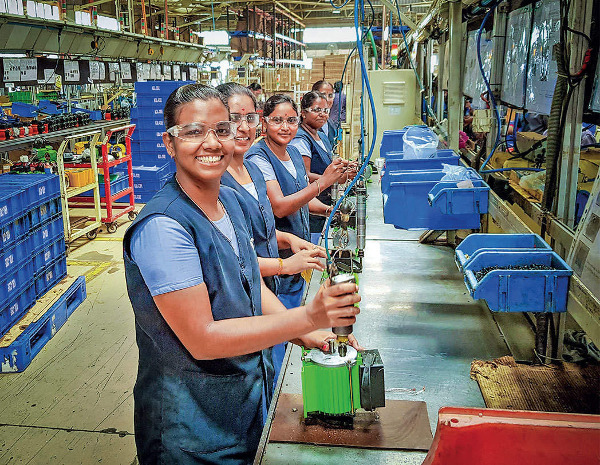
India’s business landscape has undergone a significant transformation over the past decade, driven by a series of structural reforms aimed at improving the ease of doing business (EoDB) and strengthening investor confidence. Through regulatory simplification, digital governance, financial sector reforms and institutional initiatives, the government has sought to create a transparent and growth-oriented ecosystem that encourages entrepreneurship, innovation and investment.
One of the most visible indicators of this transformation is the growth in enterprise registrations. According to official data, the number of active registered companies in India rose from 1.55 lakh in 2020–21 to 1.98 lakh in 2025–26, marking an increase of nearly 27 percent within five years. This surge reflects the expanding entrepreneurial base and improved regulatory environment for businesses. At the same time, business sentiment has remained strong, with the Reserve Bank of India’s Business Expectations Index consistently staying above the neutral benchmark of 100 during FY 2024–25 and into FY 2025–26, signalling optimism among firms regarding output, investment and employment.
A cornerstone of India’s reform strategy has been the promotion of entrepreneurship through initiatives such as Startup India. Launched to build a robust startup ecosystem, the initiative offers recognised startups tax incentives, simplified compliance procedures and fast-tracked intellectual property processing. As of February 2026, India had over 2.16 lakh startups recognised by the Department for Promotion of Industry and Internal Trade (DPIIT), placing the country among the largest startup ecosystems in the world.
Access to finance has also been strengthened through a range of credit guarantee programmes that enable collateral-free loans to small businesses and startups. The Credit Guarantee Scheme for Micro and Small Enterprises (CGTMSE) supports loans up to ₹10 crore, while the Credit Guarantee Scheme for Startups (CGSS) provides guarantees of up to ₹20 crore per borrower. In addition, the Credit Guarantee Scheme for Exporters (CGSE) offers up to ₹20,000 crore in additional collateral-free credit to export-oriented MSMEs. These schemes have significantly reduced barriers to capital access for emerging enterprises.
Financial innovation has further been supported through the launch of a Credit Assessment Model (CAM) by public sector banks in 2025. This system uses digitally verified data to automate loan appraisals for MSMEs. Between April and November 2025, public sector banks sanctioned loans worth ₹41,500 crore from applications totalling ₹3.2 lakh crore under CAM-based credit programmes, demonstrating the growing role of digital finance in improving access to credit.
Insurance sector reforms have also contributed to improving the business climate. The Sabka Bima, Sabki Raksha (Amendment of Insurance Laws) Act, 2025 introduced significant changes to modernise the sector. Among the most notable reforms is the increase in the foreign direct investment (FDI) limit to 100 percent, which is expected to attract new capital and expand insurance coverage across the country. The legislation also simplifies regulatory procedures, including a one-time registration for intermediaries and higher approval thresholds for share transfers.
Trade and investment facilitation measures have further strengthened India’s global competitiveness. The government has proposed the development of a single interconnected digital window for cargo clearance, enabling faster approvals and reducing administrative delays. A Customs Integrated System (CIS) is also planned as a unified platform for customs processes, while advanced imaging and artificial intelligence-based scanning technologies will be deployed to enhance risk assessment and inspection efficiency at major ports.
Another major focus area has been regulatory simplification. The government’s Regulatory Compliance Burden (RCB) initiative, launched in 2020, has already eliminated more than 47,000 compliances across ministries and states. Under the expanded RCB+ programme, 4,846 additional compliances have been reduced out of 6,262 identified provisions in state legislation. Complementing this effort is the Jan Vishwas (Amendment of Provisions) Act, 2023, which decriminalised 183 provisions across 42 laws, shifting minor violations from criminal penalties to monetary fines.
Financial and corporate restructuring mechanisms have also improved through the implementation of the Insolvency and Bankruptcy Code, 2016. The law has introduced a time-bound framework for resolving distressed companies and protecting creditor interests. Since its implementation, 3,865 corporate debtors have been rescued, including 1,300 through resolution plans, while creditors have realised approximately ₹3.99 lakh crore under approved resolution plans. Recovery levels have reached nearly 170 percent of liquidation value and about 94 percent of fair value in many cases, significantly improving confidence in India’s credit ecosystem.
Reforms in taxation and labour regulations have further streamlined business operations. The rationalisation of Minimum Alternate Tax (MAT) has reduced the rate from 15 percent to 14 percent, while allowing partial utilisation of MAT credits under the new tax regime. Meanwhile, labour reforms have consolidated 29 central labour laws into four labour codes, reducing compliance complexity and introducing digital single-window registration, unified returns and simplified licensing procedures.
Tax reforms under the Goods and Services Tax (GST) framework have also deepened formalisation in the economy. The number of registered taxpayers has increased from about 60 lakh in 2017 to more than 1.6 crore in January 2026, reflecting the expanding tax base and greater integration of businesses into the formal sector.
Quality standards and manufacturing competitiveness have been strengthened through the expansion of Quality Control Orders (QCOs). As of December 31, 2025, the government had notified 143 QCOs covering 723 products, compared to just 214 products in 2019, reinforcing product safety, consumer protection and industrial competitiveness.
Taken together, these reforms illustrate a coordinated effort to modernise India’s economic governance. By combining digital governance, regulatory simplification, financial inclusion and investor-friendly policies, India is steadily building a more predictable and competitive business environment. Rising enterprise registrations, improved credit access, and strong industry sentiment suggest that these reforms are strengthening the country’s position as an emerging global hub for trade, investment and entrepreneurship.
References
- Press Information Bureau, Policy Reforms That Transformed Business Environment, Government of India (5 March 2026).
- Reserve Bank of India, Business Expectations Index reports (FY 2024–25 and FY 2025–26).
- Department for Promotion of Industry and Internal Trade, Startup India statistics (February 2026).
- Ministry of Finance, Union Budget 2026–27 policy announcements.
Source: PIB
You may also like
-
India to Build First Riverine Lighthouses on Brahmaputra to Boost Inland Waterway Navigation
-
India Assures Energy Security Amid Rising Tensions in the Middle East
-
GPS Technology Transforms Fishing Livelihoods in Car Nicobar
-
India Strengthens Self-Reliance and Expands Global Footprint with Solid Export Growth and Strategic Manufacturing
-
Industrial Production Grows 4.8% in January 2026; Manufacturing and Electricity Lead Recovery
