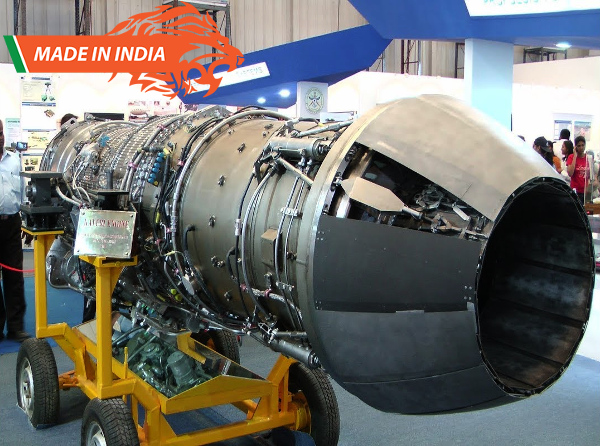
Raksha Mantri Rajnath Singh visited the Defence Research and Development Organisation’s Gas Turbine Research Establishment (GTRE) in Bengaluru on Monday to review the status of ongoing projects aimed at developing indigenous military gas turbine engines — a strategic technology critical to India’s defence manufacturing ambitions.
The visit provided the Defence Minister an opportunity to assess key initiatives underway at the premier research facility, including collaborative engagements with Indian industry, academia and other R&D institutions. He also witnessed a full afterburner engine test of the Kaveri engine and toured an exhibition showcasing a range of homegrown engines and components.
Addressing scientists and officials, Mr. Singh lauded GTRE’s efforts in advancing self-reliance in defence aerospace technology, describing DRDO as “the foundation of India’s strategic capability.” In his remarks, he stressed the critical importance of achieving technological autonomy in aero engines in the face of a rapidly evolving global geopolitical landscape. “Supply chains are breaking and new ecosystems are developing. Nations possessing indigenous critical technologies will remain safe, secure, and sustain themselves,” he said, reiterating the Government’s commitment to self-reliance across sectors.
The Raksha Mantri emphasized the need to build a robust nationwide ecosystem for aero engine development and urged scientists to push forward with next-generation propulsion technologies. He pointed to India’s ongoing efforts to design and develop the Advanced Medium Combat Aircraft (AMCA) and said the country must not limit itself to fifth-generation engines alone. Instead, he called for early work on sixth-generation and other advanced systems, citing the increasing role of artificial intelligence, machine learning and new materials in modern aerospace engineering.
Describing aero engine development as a highly complex undertaking — requiring mastery of thermodynamics, fluid mechanics, material science and advanced mechanical engineering — Mr. Singh noted that even established aerospace powers often take decades to develop next-generation propulsion systems. He urged Indian scientists to “compress timelines” and adopt a sense of urgency, saying, “We must assume that 20 years have already passed and we now have only 5–7 years left.”
The Defence Minister also highlighted the role of Operation Sindoor — a recent high-profile military action — as demonstrating the growing self-reliance of India’s defence forces. He said that communications, surveillance and attack capabilities used during the operation were predominantly indigenous, boosting both soldier morale and national pride.
Mr. Singh further welcomed international collaborations under the National Aero Engine Mission, noting joint studies with the United Kingdom and an ongoing process with France to facilitate technology exchange and mutual learning in aero engine development. He described these partnerships as opportunities to gain insights into challenges faced by advanced engine programmes abroad.
The Defence Minister also underscored the dual-use potential of complex aerospace technologies. He pointed out that innovations such as high-temperature composites being developed at GTRE could benefit civil aviation, power generation and space sectors in the long term, especially as India grows into one of the world’s fastest-expanding aviation markets.
Mr. Singh used the occasion to highlight broader geopolitical and economic developments, including the long-pending India–European Union free trade agreement, which he said reflects India’s rising global economic influence. He also referenced his recent discussions with the Defence Minister of Greece, who, according to Mr. Singh, views India as not just an emerging power but a full-fledged global leader.
The visit was attended by senior officials from DRDO and the Department of Defence R&D, including Secretary and Chairman Dr. Samir V. Kamat, along with a host of scientists and technical experts.
You may also like
-
India Strengthens Maritime Security with ₹5,083 Crore Defence Contracts for Helicopters and Naval Missiles
-
INS Sudarshini Reaches Alexandria After Landmark Suez Canal Transit
-
Defence Research and Development Organisation Successfully Conducts VSHORADS Flight Trials
-
Indian Air Force Conducts Spectacular ‘Vayushakti-26’ at Pokhran Field Firing Range
-
India’s Space Ecosystem Gets Cyber Shield as SIA-India, CERT-In Release Joint Guidelines
