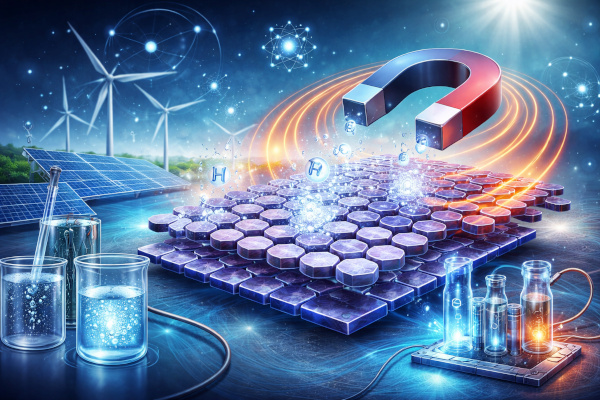
A team of Indian scientists has developed a novel nanomaterial that could significantly improve the efficiency of hydrogen production, opening new possibilities for the future of clean energy. The breakthrough involves the creation of quasi-two-dimensional tellurium nanosheets, a material capable of controlling both magnetism and catalytic activity within a single platform.
The research was carried out by scientists at the Institute of Nano Science and Technology, an autonomous institute under the Department of Science and Technology. Their findings demonstrate how advanced nanoscale materials can play a transformative role in improving green hydrogen production technologies, which are considered vital for a sustainable energy future.
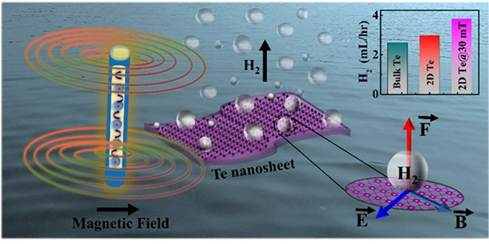
Fig: Magnetic field‑induced hydrogen evolution on a 2D Te nanosheet. Under an applied magnetic field, unpaired surface spins on the α‑Te nanosheet generate hydrogen gas bubbles, with enhanced performance at higher fields.
A New Material for Next-Generation Technologies
As electronic and energy devices continue to shrink in size, conventional materials increasingly face limitations such as instability and loss of functionality. This has prompted scientists worldwide to explore alternative materials capable of maintaining performance at the nanoscale.
One promising candidate is two-dimensional tellurium, a material predicted to exhibit unusual magnetic and electronic properties when reduced to extremely thin layers. Earlier theoretical studies suggested that modifying the crystal structure of tellurium—particularly by breaking inversion symmetry and introducing strain—could unlock new phenomena such as spin-orbit-driven magnetism and ferroelectricity.
Building on these predictions, researchers at INST have successfully engineered a new nanomaterial known as quasi-2D α-tellurium nanosheets, which exhibit an emergent ferromagnetic state. This unique combination of properties could make hydrogen-producing electrolysers more efficient by reducing the energy required for chemical reactions involved in water splitting.
Improving Green Hydrogen Production
Hydrogen generated through renewable energy sources—often referred to as green hydrogen—is widely regarded as a key component of future low-carbon energy systems. However, the process of producing hydrogen from water typically requires significant electricity input.
The newly developed nanosheets offer a potential solution. Their magnetoelectric properties allow researchers to manipulate catalytic activity using magnetic fields and electric fields. This interaction lowers the voltage required for hydrogen generation and accelerates the reaction rate, thereby reducing the overall electricity consumption during electrolysis.
The result is a more energy-efficient hydrogen evolution reaction (HER), a critical step in producing hydrogen fuel.
Advanced Techniques Behind the Discovery
The development of the nanosheets involved a combination of advanced experimental techniques. Scientists employed scalable liquid-phase exfoliation to separate bulk tellurium into ultra-thin layers. They then introduced strain-engineered lattice distortions to modify the atomic structure and activate new electronic properties.
Using specialised spin-sensitive measurement probes, the researchers were able to track the behaviour of electrons on the nanosheet surface. Their experiments showed that when bulk tellurium is converted into quasi-2D nanosheets, previously suppressed electron spins become unpaired, leading to a ferromagnetic state.
This discovery was led by **Dipankar Mandal and his doctoral student Dalip Saini. Their work revealed that the unpaired electron spins—originating from the 5p orbitals of tellurium—are directly linked to surface strain and structural symmetry breaking in the nanosheets.
Magnetism Meets Catalysis
One of the most remarkable aspects of the discovery is the strong coupling between surface magnetism and ferroelectricity within the nanosheets. This coupling produces a giant magnetoelectric response, allowing the researchers to manipulate catalytic activity using external magnetic fields.
The team demonstrated that applying a magnetic field enhances the hydrogen evolution reaction, leading to faster formation of hydrogen gas bubbles on the nanosheet surface.
Their findings, published in the prestigious journal Advanced Materials, highlight a new class of elemental nanomaterials capable of integrating multiferroicity, spintronics, and electrocatalysis within a single platform.
Unlike many existing magnetic materials that rely on transition-metal ions or complex compounds, this system uses pure elemental tellurium, making the approach comparatively simpler and potentially easier to scale.
Broad Technological Applications
Beyond hydrogen production, the newly developed nanosheets could have applications across several emerging technologies. The unique combination of ferromagnetism, ferroelectricity, and piezoelectricity makes the material attractive for fields such as spintronics, nanoelectronics, and advanced sensing systems.
Potential applications include low-power memory devices, smart environmental sensors, and magnetoelectric-driven electrolysers designed to produce hydrogen more efficiently.
Furthermore, the stability and flexibility of the nanosheets make them suitable for flexible, portable, and wearable technologies. Such systems could support new energy solutions while also enabling real-time environmental and health monitoring.
Toward a Sustainable Energy Future
The discovery of quasi-2D α-tellurium nanosheets highlights the growing importance of nanomaterials research in addressing global energy challenges. By enabling more efficient hydrogen production and linking multiple advanced technologies within a single material, the research opens promising pathways for future clean-energy systems.
As countries around the world seek sustainable alternatives to fossil fuels, innovations like this could play an important role in accelerating the development of low-carbon energy infrastructure and next-generation electronic technologies.
Publication link: ITTEN
Reference
- Press Information Bureau – “Newly developed nanosheets bring potential for future clean-energy production,” March 10, 2026.
- Research published in Advanced Materials.
You may also like
-
India Moves Toward Satellite Life-Extension Technology with Support for OrbitAID
-
Two New Chicks Mark Milestone in Great Indian Bustard Conservation Programme
-
Scientists Solve Long-Standing Puzzle of Heat Transport in Magnetic Semiconductors
-
India’s AI-Driven Telecom Security Platform ‘FraudPro’ Among Global Finalists at Mobile World Congress 2026
-
Indian Scientists Rewrite a 50-Year-Old Rule of Bacterial Gene Regulation
