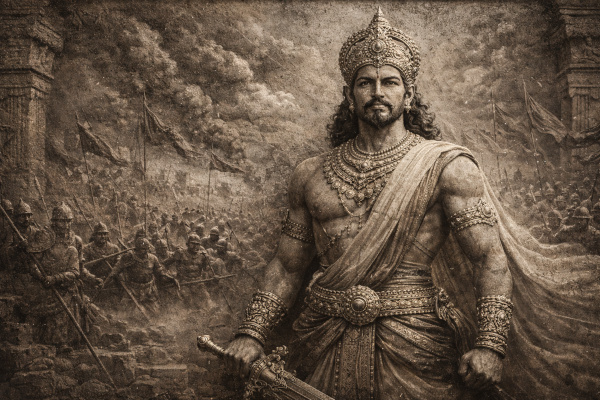
In the windswept hills of present-day Odisha, carved into living rock, survives the voice of a king who refused to let history forget him. His name was Kharavela, ruler of ancient Kalinga, and one of the most dynamic yet underappreciated monarchs of early Indian history. While names like Ashoka and Chandragupta dominate popular memory, Kharavela stands apart as a ruler who rebuilt a nation shattered by invasion, expanded its military prestige, invested in public welfare, and left behind one of the most detailed royal autobiographies of ancient India.
Our principal source for his life is the famous Hathigumpha Inscription, engraved in a cave on the Udayagiri hills near Bhubaneswar. Written in early Brahmi script and Prakrit language, this inscription narrates his achievements year by year — something remarkably rare for that period. Unlike many rulers whose deeds are reconstructed through later chronicles, Kharavela speaks directly to us across two millennia.
To understand his importance, one must recall that Kalinga had been devastated about a century earlier by the conquest of Ashoka of the Mauryan Empire around 261 BCE. Ancient records speak of over 100,000 people killed and 150,000 deported during that brutal campaign. The trauma of that war famously transformed Ashoka into a proponent of dhamma, but for Kalinga, the scars remained. When Kharavela ascended the throne, likely in the 1st century BCE (most scholars place him around 170–150 BCE or slightly later), he inherited not a flourishing imperial state, but a region rebuilding its pride and power.
From the inscription, we learn that Kharavela was well educated in statecraft, law, economics, and military arts from a young age. At 24, he was crowned king. His reign, as described in the Hathigumpha record, reads almost like a royal diary of ambition and action.
In his very first year of his reign, he focused not on conquest, but reconstruction. He repaired city gates, fortified walls, and public buildings damaged by storms. He invested heavily in infrastructure — irrigation canals, reservoirs, gardens, and entertainment halls. One canal project mentioned in the inscription may have revived an ancient water system originally built during Nanda rule centuries earlier. This indicates not only engineering vision but also administrative continuity. For a region dependent on agriculture, irrigation meant food security, tax stability, and social peace.
But Kharavela was no mere administrator. By his second year, he mobilized a large army and launched campaigns westward. The inscription claims he frightened powerful southern polities and forced neighboring rulers to retreat. By the fourth year, he had reportedly advanced northward, challenging powers in the Gangetic plains. One dramatic claim suggests he compelled a ruler of Magadha, whose capital was Pataliputra, to submit or retreat. While historians debate the literal accuracy of every conquest, there is little doubt that Kalinga re-emerged during his reign as a formidable regional power.
The inscription also mentions that he retrieved a sacred Jain idol that had been carried away by a previous Magadhan king generations earlier. This act was not merely religious; it was symbolic. It was a declaration that Kalinga would reclaim what had been taken — materially, culturally, and spiritually.
Kharavela’s religious policy is particularly fascinating. Though often associated strongly with Jainism — and credited with patronizing Jain monks and institutions — he appears to have been remarkably tolerant. The inscription records donations and constructions benefiting various religious groups. His reign predates the rigid sectarian divides that would later shape Indian religious politics. Instead, it reflects a ruler confident enough to support plural traditions without insecurity.
Architecturally, his legacy survives in the caves of Udayagiri Caves, where monastic dwellings were carved with surprising sophistication. These were not mere shelters but carefully designed spaces for ascetics, complete with sculptural ornamentation and symbolic motifs. They reflect both royal patronage and an aesthetic vision blending piety with power.
Economically, the scale of his public works suggests a stable treasury. Large-scale construction, military campaigns, and civic festivals require revenue discipline. The inscription even describes grand public entertainments — music, dance, festivals — suggesting a ruler who understood morale as a political tool. A prosperous population is easier to govern; a proud population is harder to conquer.
Yet what makes Kharavela vivid is not only his victories, but his personality as revealed through the inscription. There is confidence, even theatricality, in the way his deeds are narrated. He presents himself as protector, conqueror, patron, and restorer — all in one. It is political branding in stone. Modern readers might even detect a proto-nationalist tone: the revival of Kalinga’s dignity after foreign domination.
Historians debate the exact chronology of his reign, partly because the inscription is weathered and some passages are damaged. But most agree that he ruled for at least 13 years and transformed Kalinga into a central power of eastern India. Unlike the Mauryas, whose empire eventually fragmented, Kharavela’s state appears more regionally anchored yet resilient.
What is striking is how history treated him afterward. Without a vast pan-Indian empire or a missionary religious campaign like Ashoka’s, his memory faded from mainstream narratives. Yet archaeologically and epigraphically, he stands as one of the earliest Indian rulers to leave such a detailed personal political record.
In real-life terms, Kharavela represents the archetype of a post-crisis leader — one who inherits humiliation and rebuilds confidence. He invested in infrastructure before aggression, secured internal stability before expansion, and used culture as a unifying force. His reign suggests that revival after defeat is not merely possible; it can produce leaders more dynamic than those who inherit peace.
Today, as one stands before the weathered letters of the Hathigumpha inscription, one senses not just history but intention. Kharavela wanted to be remembered. He wanted future generations to know that Kalinga rose again. And in that rocky cave, against time and erosion, his voice still echoes.
End Notes & References
- Hathigumpha Inscription – Archaeological Survey of India
https://asi.nic.in/ - Detailed Translation and Analysis – Epigraphia Indica (Archaeological Survey publications)
https://archive.org/details/epigraphia-indica - R. D. Banerji, History of Orissa (discussion on Kharavela)
https://archive.org/details/historyoforissa - K. P. Jayaswal, Hathigumpha Inscription of Kharavela
https://archive.org/details/hathigumphainscription - Upinder Singh, A History of Ancient and Early Medieval India (Academic reference)
You may also like
-
Global Dance Overture Brings Indo–Russian Cultural Harmony to Kamani Theatre
-
INSV Kaundinya Returns to Mumbai: A Voyage that Revives India’s Ancient Maritime Glory
-
The Forgotten War on the Western Coast: The Story of Rani Abbakka Chowta
-
Cabinet Approves Alteration of the Name of the State of “Kerala” to “Keralam”
-
Chakravarti Rajagopalachari: The Indian Statesman Who Formally Ended British Rule
