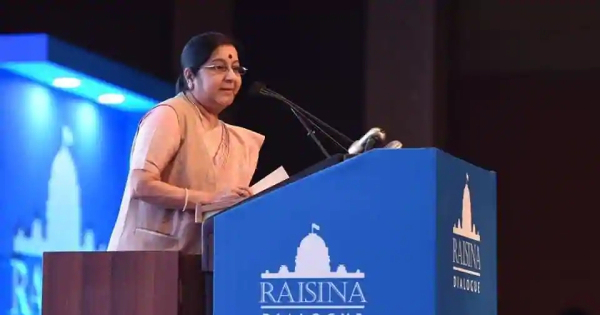
The theme of the Raisina Dialogue this year is ‘A World Reorder’ with the Ministry of External Affairs (MEA) as its partner.
The theme of the Raisina Dialogue this year is ‘A World Reorder’ with the Ministry of External Affairs (MEA) as its partner.
India’s External Affairs Minister Sushma Swaraj has said that the need of the hour is to ensure zero tolerance towards terrorism and those using it as an ‘instrument of convenience.
“Our revitalised ‘Act East and Think West’ paradigms have further broadened the reach of our strategic and economic ‘neighbourhood’, she says.
Asserting in her address at the 4th Raisina Dialogue in New Delhi, that no country was immune to the “existential threat” of terrorism, she said that each global interaction is now focused on building partnerships to promote our transformative flagship programmes such as Make in India, Smart Cities, Digital India, AMRUT and Namami Gange.
The theme of the Raisina Dialogue this year is ‘A World Reorder’ with the Ministry of External Affairs (MEA) as its partner. She stressed on various on issues around the emerging global and regional trends.
Talking about the “critical challenges” that confront the world, she said the first among them is terrorism. According to the minister “There was a time when India would talk about terrorism and it would be treated as a law and order issue at many global platforms. Today, no country, big or small, is immune to the existential threat, particularly terrorism actively supported and sponsored by states”.
In this digital age, the challenge posed by terrorism is even greater with more vulnerability to radicalisation.
To this day countries cannot agree on a common definition of terrorism, because of which India’s proposed Comprehensive Convention on International Terrorism at the United Nations in 1996, remains a draft to this day.
“Ensuring zero tolerance towards terrorism and towards those using it as an instrument of convenience is the need of the hour,” the external affairs minister said.
She said the threat of proliferation of weapons of mass destruction and climate change were also major challenges facing the international community.
Developing and under-developed nations are the worst victims of climate change, with neither the capacity nor the resources to meet the crisis. In partnership with France, India launched the International Solar Alliance earlier this year with the participation of 120 countries.
India’s External Affairs Minister Sushma Swaraj has said that the need of the hour is to ensure zero tolerance towards terrorism and those using it as an ‘instrument of convenience.
“Our revitalised ‘Act East and Think West’ paradigms have further broadened the reach of our strategic and economic ‘neighbourhood’, she says.
Asserting in her address at the 4th Raisina Dialogue in New Delhi, that no country was immune to the “existential threat” of terrorism, she said that each global interaction is now focused on building partnerships to promote our transformative flagship programmes such as Make in India, Smart Cities, Digital India, AMRUT and Namami Gange.
The theme of the Raisina Dialogue this year is ‘A World Reorder’ with the Ministry of External Affairs (MEA) as its partner. She stressed on various on issues around the emerging global and regional trends.
Talking about the “critical challenges” that confront the world, she said the first among them is terrorism. According to the minister “There was a time when India would talk about terrorism and it would be treated as a law and order issue at many global platforms. Today, no country, big or small, is immune to the existential threat, particularly terrorism actively supported and sponsored by states”.
In this digital age, the challenge posed by terrorism is even greater with more vulnerability to radicalisation.
To this day countries cannot agree on a common definition of terrorism, because of which India’s proposed Comprehensive Convention on International Terrorism at the United Nations in 1996, remains a draft to this day.
“Ensuring zero tolerance towards terrorism and towards those using it as an instrument of convenience is the need of the hour,” the external affairs minister said.
She said the threat of proliferation of weapons of mass destruction and climate change were also major challenges facing the international community.
Developing and under-developed nations are the worst victims of climate change, with neither the capacity nor the resources to meet the crisis. In partnership with France, India launched the International Solar Alliance earlier this year with the participation of 120 countries.
Source:FE
Image Source:FlipBoard
You may also like
-
India’s Strategic Rise Through Free Trade Agreements: Achievements and Impact (2025–26)
-
India–Finland Ties Enter New Phase as President Alexander Stubb Concludes State Visit to India
-
India–Canada Ties Get Strategic Push as Prime Minister’s Visit Yields Major Agreements Across Trade, Energy and Technology
-
INS Sudarshini Reaches Alexandria After Landmark Suez Canal Transit
-
Global Dance Overture Brings Indo–Russian Cultural Harmony to Kamani Theatre
