In a breakthrough that adds a new layer to our understanding of how stars are born, Indian scientists have traced the magnetic field structures surrounding two small molecular clouds near the Milky Way’s disc, effectively revealing the “skeleton” of these otherwise invisible cosmic forces for the first time. The study focuses on two dark molecular clouds, L1604 and L121, and shows how magnetic fields help regulate the process of star formation by resisting gravitational collapse.
For decades, astronomers have understood star formation largely as a contest between gravity, which pulls gas and dust inward, and internal pressure, which pushes outward. But this new work highlights a third and often unseen force: the magnetic field. According to the researchers, magnetism can act as a stabilising influence, slowing down collapse and preventing molecular clouds from converting all their gas into stars too quickly.
The research was carried out by a team from the Aryabhatta Research Institute of Observational Sciences (ARIES), an autonomous institute under the Department of Science and Technology, along with Assam University. To study the magnetic environment of the clouds, the team used R-band polarimetry with the ARIES Imaging Polarimeter (AIMPOL) mounted on the 104-cm ARIES telescope at Nainital. This technique allowed them to measure how starlight becomes polarized after passing through dust grains aligned by magnetic fields. By mapping these polarization signatures, the scientists were able to infer the otherwise invisible magnetic field geometry surrounding the clouds.
The two molecular clouds examined in the study turned out to have very different characteristics. L1604, located toward the Galactic anticentre, lies at a distance of around 816 parsecs and is denser and more massive, with enough material to potentially form many new stars. L121, located toward the Galactic centre, is much closer at about 124 parsecs—nearly seven times closer than L1604—but is less dense and less massive. What makes L121 especially interesting is that it appears to possess a stronger and more orderly magnetic field, suggesting it has not yet been strongly distorted by the violent gravitational collapse seen in more active star-forming regions.
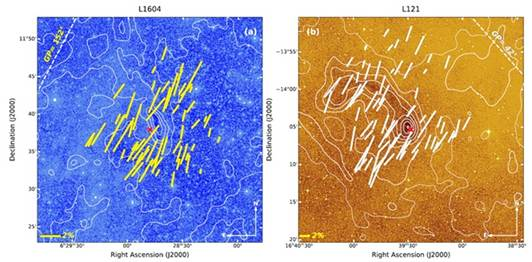
Fig: Polarization maps of dark clouds L1604 and L121. Solid lines represent the polarization vector corresponding background stars overlaid on the composite DSS images of the respective clouds. The orientation of the Galactic Plane (GP) is marked with a dashed line. The cross denotes the central position of each cloud. Contours of the Herschel SPIRE 500 μm dust continuum emission are over plotted.
One of the most important findings of the study is that both clouds are firmly sub-critical. In astronomical terms, that means their magnetic fields are strong enough to resist collapse across the bulk of the cloud. The researchers found that magnetic energy dominates over both turbulence and gravity at the envelope scale, with magnetic energy greater than turbulent kinetic energy, and turbulent energy greater than gravitational energy. This suggests the clouds as a whole are still magnetically supported. Yet the study also indicates that in the dense inner cores of these clouds, gravity may gradually begin to take over, creating the actual birthplaces of future stars even while the larger cloud remains protected by magnetic structure.
That makes the discovery especially important. Rather than viewing molecular clouds as simple masses of gas collapsing under gravity, the new findings show that star formation is a much more delicate and controlled process. Magnetic fields do not merely exist in the background; they actively shape the structure, pace, and evolution of stellar nurseries. In that sense, the study offers a clearer picture of the “recipe” for star birth inside small low-mass molecular clouds.
The research also matters beyond these two specific clouds. Because rarely observed small molecular clouds like L1604 and L121 are less chaotic than giant star-forming regions, they provide cleaner natural laboratories for studying the fundamental balance between gravity, turbulence, and magnetism. The published paper in Monthly Notices of the Royal Astronomical Society presents the work as a detailed investigation into the magnetic field morphology and physical structure of these clouds, helping improve our broader understanding of low-mass star-forming environments.
In simple terms, what the scientists have shown is this: stars are not born through gravity alone. Hidden magnetic fields quietly shape when, where, and how a cloud gives way to star formation. L1604 and L121, once seen as little more than dark patches in space, are now emerging as living laboratories where some of the universe’s most important forces can be watched in slow motion over millions of years.
Publication link: https://academic.oup.com/mnras/article/545/4/staf2228/8382486?login=true
Source: PIB
You may also like
-
India Takes Key Step in Rare Earth Self-Reliance with Nd-Fe-B Magnet Pilot Plant in Hyderabad
-
Scientists Decode the Ancient Geological Story Behind the Ladakh Range
-
India Expands Quantum Research Push as 23 Institutions Get Labs, 100 More Under Review
-
Ancient Greenland Cooling Event Weakened Indian Monsoons 8,200 Years Ago, Study Finds
-
India Moves Toward Satellite Life-Extension Technology with Support for OrbitAID
