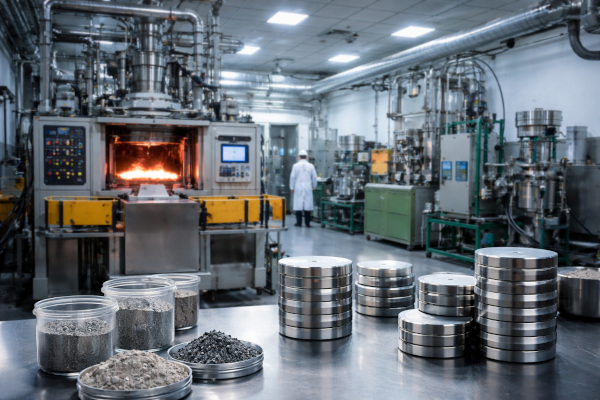
In a major move toward strengthening India’s position in critical materials and advanced manufacturing, a pilot plant for the production of Nd-Fe-B rare earth permanent magnets has been established at the International Advanced Research Centre for Powder Metallurgy and New Materials (ARCI), Hyderabad. The facility, set up under the Department of Science and Technology (DST), is being seen as an important step in reducing India’s dependence on global supply chains for strategically vital materials.
The pilot plant was inaugurated by Prof. Abhay Karandikar, Secretary, DST, in the presence of senior scientists, policymakers, industrial representatives, and other stakeholders. Among those present were Dr. R. Vijay, Director of ARCI, Prof. Ashutosh Sharma, former DST Secretary and Chairman of the ARCI Governing Council, Dr. S. K. Jha, former CMD of MIDHANI, and Dr. Shivkumar Kalyanaraman, CEO of the Anusandhan National Research Foundation (ANRF).
What makes this facility particularly significant is that it has been designed with an end-to-end manufacturing approach. That means it covers the full process chain — from strip-cast alloy production to finished sintered magnets — rather than focusing on just one segment of the production cycle. This is important because rare earth magnet manufacturing is not just about raw materials, but about developing a complete industrial ecosystem that can support design, process optimization, scaling, and final product development within the country.
Nd-Fe-B, or Neodymium-Iron-Boron magnets, are among the most powerful permanent magnets used in modern industry. They are essential in electric vehicles, renewable energy systems, electronics, and advanced manufacturing technologies. As India pushes for faster growth in clean energy, electric mobility, and high-tech industrial capacity, demand for such magnets is expected to rise sharply. At the same time, global supply chains for rare earth magnets remain heavily concentrated in a small number of countries, creating strategic and economic vulnerabilities for nations like India.
That is why this new pilot plant matters. According to Prof. Karandikar, the facility is an important step toward building strategic autonomy in critical materials, especially at a time when global supply chains are increasingly uncertain. He said that as India moves toward its long-term Viksit Bharat 2047 vision, strengthening indigenous capabilities in critical technologies will be central to national development. In practical terms, this means building the ability to produce essential materials at home rather than relying excessively on imports that may be vulnerable to geopolitical disruptions or market shocks.
The plant is also expected to serve as more than just a production unit. It will function as a platform for technology validation, process optimization, and industrial demonstration, helping bridge the gap between laboratory research and commercial manufacturing. This is often one of the most difficult stages in deep-tech sectors, where promising technologies fail to scale because pilot-level validation and industry collaboration are missing. By creating this intermediate platform, the government and ARCI are trying to make the transition from research to manufacturing more viable.
Former DST Secretary Prof. Ashutosh Sharma underlined this point, noting that the real importance of the plant lies in its role as a bridge from scientific research to manufacturing. Because the facility is flexible, it can support continuous innovation, process refinement, and new product development, making it a living platform rather than a one-time installation.
ARCI Director Dr. R. Vijay said the institution is working on developing a complete “mineral-to-market” ecosystem, spanning everything from rare earth extraction to final magnet manufacturing. That phrase is important because it captures the broader ambition of the project. The goal is not merely to manufacture a magnet, but to create a linked value chain in India that connects raw material sourcing, research, process engineering, industrial collaboration, and eventual commercialization.
The pilot plant is also expected to play a wider role in encouraging industry participation, startup involvement, and private-sector engagement in rare earth technologies. Dr. Shivkumar Kalyanaraman, CEO of ANRF, referred to the Mission for Advancement in High-impact Areas (MAHA) initiative and stressed the need for stronger private sector participation in translational research, especially in critical sectors such as India’s emerging EV ecosystem.
This matters because rare earth permanent magnets are no longer niche products. They sit at the heart of some of the most important technologies shaping the future economy — from electric mobility and wind power to robotics and precision electronics. A country that can produce these materials and components domestically gains not just industrial capacity, but also strategic leverage in an increasingly competitive global environment.
The Hyderabad pilot plant therefore represents more than a scientific achievement. It signals India’s intent to build resilience in a sector that will be crucial for future manufacturing, energy transition, and technological competitiveness. If the initiative succeeds in attracting industry partnerships and scaling indigenous innovation toward commercial production, it could become a foundational step in India’s larger effort to build a self-reliant advanced materials ecosystem.
In that sense, the project fits squarely within the broader vision of Atmanirbhar Bharat and Viksit Bharat 2047. It is a reminder that self-reliance in the modern world is not just about producing more, but about mastering the materials and technologies that define the next generation of industry.
Source: PIB
You may also like
-
Indian Scientists Uncover Magnetic “Skeleton” of Star-Forming Clouds Near Milky Way
-
Scientists Decode the Ancient Geological Story Behind the Ladakh Range
-
Subansiri Lower Hydroelectric Project Advances as Two Units Begin Power Generation
-
India Expands Quantum Research Push as 23 Institutions Get Labs, 100 More Under Review
-
Ancient Greenland Cooling Event Weakened Indian Monsoons 8,200 Years Ago, Study Finds
