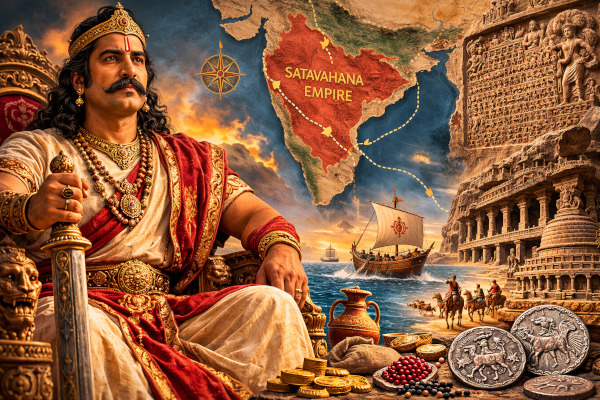
In the vast panorama of ancient Indian history, the story of the Deccan is often overshadowed by the empires of the Gangetic plains. Yet the Deccan plateau produced powerful dynasties that shaped the political and economic life of the subcontinent for centuries. Among them, the Gautamiputra Satakarni stands out as one of the most remarkable rulers of early historic India. Revered as the greatest king of the Satavahana dynasty, Gautamiputra Satakarni ruled in the early second century CE and restored the power of a kingdom that had nearly collapsed under the pressure of foreign invasions and internal decline. His reign represents not only a political revival but also an important chapter in the struggle for control over India’s lucrative trade networks and strategic regions.
The Satavahanas had emerged as one of the first major dynasties of the Deccan after the decline of the Mauryan Empire in the second century BCE. Over time they built a kingdom that extended across large parts of central and southern India. However, by the beginning of the second century CE the dynasty had entered a period of crisis. Powerful foreign rulers known in Indian sources as the Sakas, Yavanas, and Pahlavas had established control over many important territories in western India. Among these rulers the most formidable was the Western Kshatrapa king Nahapana, who had expanded his authority across Gujarat, Malwa, and northern Maharashtra. These regions were not merely politically important; they controlled key trade routes connecting the interior of India with major ports along the Arabian Sea. Whoever controlled these routes commanded immense wealth generated through international commerce with the Roman world.
It was into this turbulent political landscape that Gautamiputra Satakarni emerged as a ruler of extraordinary determination and ambition. The exact chronology of his reign is still debated by historians, but most scholars place it around 106–130 CE. Much of what is known about him comes from inscriptions and coins, particularly the famous inscription issued by his mother Gautami Balashri at the Nasik Caves, also known as the Trirashmi caves. This inscription provides a vivid portrait of the king and celebrates his achievements in grand language. Gautamiputra Satakarni is praised as the destroyer of the Sakas, Yavanas, and Pahlavas and as the restorer of the Satavahana dynasty’s prestige. The inscription portrays him as a ruler who crushed foreign domination and reestablished indigenous authority across the Deccan.
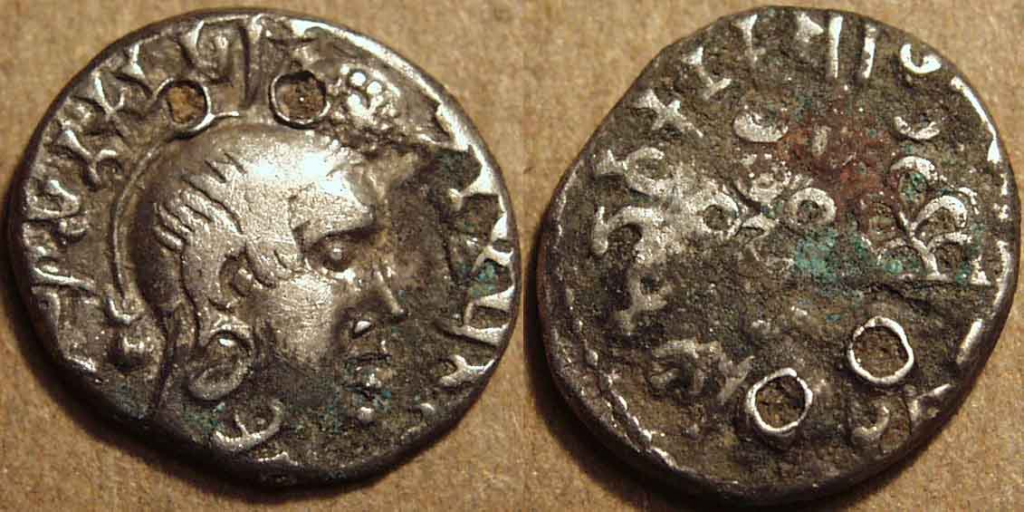
The most decisive moment of his reign came in his confrontation with Nahapana and the Western Kshatrapas. Nahapana had established a powerful kingdom that stretched across western India and dominated important commercial centres. For the Satavahanas, the loss of these territories meant not only political humiliation but also severe economic decline. Gautamiputra launched a series of campaigns that ultimately defeated Nahapana and reclaimed the lost regions. The evidence for this victory survives dramatically in the form of coins. Archaeologists have discovered large numbers of Nahapana’s silver coins that were later overstruck with the name and symbols of Gautamiputra Satakarni, a striking gesture of political symbolism. By stamping his authority over the coins of his defeated rival, Gautamiputra publicly announced the restoration of Satavahana supremacy.
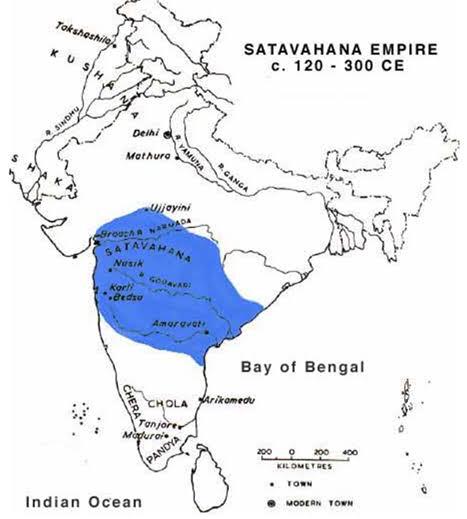
Following these victories, the Satavahana Empire expanded into one of the largest political entities of peninsular India during the early centuries of the Common Era. The territories under Gautamiputra’s authority included large parts of present-day Maharashtra, Telangana, Andhra Pradesh, Madhya Pradesh, and possibly regions of Gujarat and Rajasthan. The Nasik inscription proudly proclaims that he ruled lands stretching from the Arabian Sea to the eastern regions of the Deccan, reflecting the broad geographical reach of his power. Such territorial expansion transformed the Satavahana state into a major political force capable of competing with other regional powers of the time.
Gautamiputra Satakarni’s reign was also significant for the role it played in restoring economic vitality to the Deccan. During the first centuries of the Common Era, India was deeply integrated into global trade networks that linked the Mediterranean world with the Indian Ocean. Roman merchants sailed across the Arabian Sea to ports along India’s western coast, seeking spices, textiles, precious stones, ivory, and exotic goods. Classical sources such as the Periplus of the Erythraean Sea and the writings of Pliny the Elder describe the thriving commerce between India and the Roman Empire. Control over western Indian ports and inland trade routes therefore meant access to enormous wealth. By defeating Nahapana and reclaiming these strategic regions, Gautamiputra restored Satavahana access to this international trade network. Archaeological discoveries of Roman coins in peninsular India testify to the scale of commercial exchange that flourished during this era.
The Nasik inscription also reveals how Gautamiputra Satakarni presented himself as a guardian of social and cultural order. The text describes him as a ruler who protected the traditional fourfold social structure and upheld dharma. Historians interpret this not merely as religious rhetoric but as a political statement aimed at emphasizing the restoration of indigenous rule after the period of foreign domination. Yet the Satavahana kingdom was far from culturally rigid. Archaeological evidence from across the Deccan shows that Satavahana rulers supported a wide range of religious traditions, including Buddhism and Brahmanical practices. The caves at Nasik and other sites across Maharashtra contain inscriptions recording donations made by Satavahana officials and merchants to Buddhist monastic communities, reflecting the religious diversity of the region.
Gautamiputra Satakarni’s influence did not end with his death. His achievements laid the foundations for continued Satavahana strength under his successors, particularly Vasisthiputra Pulumavi, who maintained the dynasty’s authority across large parts of the Deccan. Even centuries later, Gautamiputra remained celebrated in inscriptions and historical memory as the ruler who revived the fortunes of his dynasty and secured the political independence of the Deccan.
In the broader sweep of Indian history, Gautamiputra Satakarni represents the resilience of regional powers and the dynamic political landscape that existed beyond the imperial centres of northern India. His reign illustrates how control over trade, military leadership, and cultural legitimacy could combine to produce one of the most powerful rulers of the early historic period. Though his name is not as widely recognized as some later emperors, Gautamiputra Satakarni stands among the great architects of ancient Indian power, a king whose victories reshaped the political and economic map of the Deccan nearly two thousand years ago.
References and Citations
- Early History of the Deccan
- The Satavahanas and the Western Kshatrapas
- The Wonder That Was India
- Ancient Indian Historical Tradition
- Periplus of the Erythraean Sea
- Pliny the Elder – Natural History
- Archaeological Survey of India reports on Nasik Cave inscriptions
- Numismatic evidence of Satavahana and Western Kshatrapa coinage
You may also like
-
Chanakya Niti – Chapter 3
-
Iran and Sanātana Dharma: Ancient Civilizational Echoes Across the Indo-Iranian World
-
Global Dance Overture Brings Indo–Russian Cultural Harmony to Kamani Theatre
-
Kharavela: The Lion of Kalinga Who Rewrote Power, Piety and Prestige in Ancient India
-
INSV Kaundinya Returns to Mumbai: A Voyage that Revives India’s Ancient Maritime Glory
