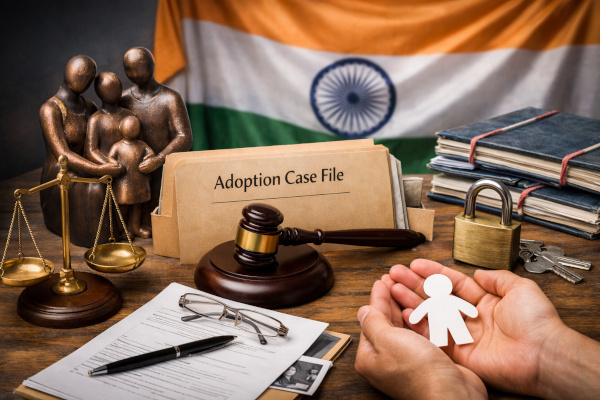
The Central Adoption Resource Authority (CARA), a statutory body functioning under the Ministry of Women and Child Development, Government of India, has issued a series of nationwide directives aimed at strengthening adoption procedures, safeguarding adoption records, and ensuring strict protection of children’s identities across the country. The directions have been communicated to all State Adoption Resource Agencies (SARAs) through three Office Memorandums issued in accordance with the provisions of the Juvenile Justice (Care and Protection of Children) Act, 2015, as amended in 2021, and the Adoption Regulations, 2022.
Adoption under the Juvenile Justice framework is intended to secure the right of every orphaned, abandoned, or surrendered child to grow up in a family environment. Section 56(1) of the Act recognizes adoption as a means of ensuring a permanent and stable family for such children. In line with this principle, CARA has emphasised the need for strict compliance with statutory procedures before a child is declared legally free for adoption.
Through the first Office Memorandum, CARA has reiterated that all procedural safeguards and timelines laid down under the law must be strictly followed before any orphan or abandoned child is declared legally free for adoption. The Authority clarified that such a declaration cannot be made without completing the required inquiry, making efforts to trace biological parents, and undertaking restoration measures wherever possible within the prescribed timeframe.
The memorandum further emphasised that in the case of surrendered children, the mandatory reconsideration period of two months must be observed before declaring the child legally free for adoption. This provision is designed to ensure that biological parents who have surrendered a child are given an opportunity to reconsider their decision within the legally stipulated period. CARA has directed all agencies involved in the adoption process to strictly adhere to these provisions to maintain transparency and procedural integrity in the adoption system.
In a second Office Memorandum, CARA addressed the issue of preservation and safekeeping of records relating to children and adoptees. The Authority noted that adult adoptees often seek information about their origins through the “root search” process, as provided under Regulation 47(2) of the Adoption Regulations, 2022. However, in some cases, such records have been difficult to access due to the closure, de-registration, or merger of Specialized Adoption Agencies (SAAs) or Child Care Institutions (CCIs).
To address this challenge, CARA has clarified that the responsibility to preserve adoption records remains valid regardless of whether the institution that originally maintained them is still operational. States and Union Territories have therefore been instructed to ensure that all physical and digital records relating to adoptees are securely preserved and transferred to designated authorities or institutions when necessary.
The Authority has also directed that proper arrangements be made for the long-term safekeeping of these records so that adoptees seeking information about their origins in the future can access the necessary documentation through legally prescribed procedures. CARA emphasised that records must not be destroyed, discarded, or rendered inaccessible except in accordance with the legal framework governing record management. These provisions are also aligned with Section 99 of the Juvenile Justice Act, which mandates confidentiality and secure handling of records relating to children.
In a third Office Memorandum, CARA has issued instructions to all States and Union Territories to ensure strict compliance with Section 74 of the Juvenile Justice Act, which prohibits the disclosure of the identity of children who are in conflict with the law or who are in need of care and protection.
The Authority has directed State governments to issue necessary instructions to all concerned officials, institutions, and adoption agencies to ensure that photographs, videos, or any identifying information related to children residing in Specialized Adoption Agencies or Child Care Institutions are not disclosed in any form of communication, including on social media platforms.
States have also been advised to take appropriate action in cases where violations occur and to conduct awareness and sensitisation programmes for officials and staff members regarding confidentiality obligations under the law. CARA has highlighted that violations of these provisions may attract penal consequences under Section 74(3) of the Juvenile Justice Act.
The latest directives are part of a broader effort to strengthen transparency, accountability, and child protection within India’s adoption ecosystem. By reinforcing procedural safeguards, improving the management of adoption records, and ensuring strict protection of children’s identities, CARA aims to uphold the rights, dignity, and privacy of children and adoptees across the country.
The Authority has urged all State governments and Union Territory administrations to ensure strict adherence to these guidelines in order to enhance the effectiveness of the adoption framework and ensure that every child entitled to adoption receives the protection and care envisaged under the law.
Detailed OMs can be viewed:-
Source: Press Information Bureau (PIB), Ministry of Women and Child Development, Government of India.
You may also like
-
Chanakya Niti – Chapter 3
-
Government Launches Bharat-VISTAAR: AI-Powered Digital Platform for Farmers
-
District-Level Early Warning Systems Operational Across Vulnerable Regions in India: Government
-
India Moves Closer to Universal Safe Drinking Water Access by 2030
-
India’s Cheetah Population Reaches 53 as Jwala Gives Birth to Five Cubs at Kuno
