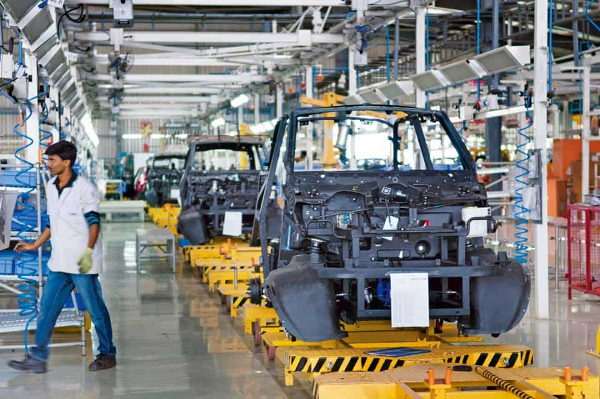
India’s automobile industry has started the new financial year with strong momentum, with domestic passenger vehicle dispatches rising 25.4 percent year-on-year to 4,37,312 units in April 2026, according to data released by the Society of Indian Automobile Manufacturers. The figure marks a sharp increase from 3,48,847 units in April 2025 and signals that demand in the passenger vehicle market remains resilient despite concerns over high commodity prices linked to disruptions in West Asia.
The April numbers are important because they represent wholesale dispatches from automobile companies to dealers, not direct retail sales to customers. Even so, they are a strong indicator of industry confidence, dealer inventory planning and expected consumer demand at the beginning of FY27. The latest data suggests that the Indian automobile sector has carried forward the demand momentum seen in the second half of FY26, helped by improved consumer sentiment and policy-linked support to vehicle affordability.
Utility vehicles continued to dominate the passenger vehicle segment. Sales of utility vehicles rose 21.5 percent to 2,44,280 units in April 2026, compared with 2,01,062 units in the same month last year. This confirms the continuing strength of India’s SUV and crossover market, where buyers are increasingly preferring higher ground clearance, larger cabins, stronger road presence and feature-rich models.
Passenger cars also posted a strong recovery during the month. Dispatches of passenger cars grew 32.7 percent to 1,20,945 units, compared with 91,148 units in April 2025. Van sales also improved, rising 14.4 percent to 13,087 units from 11,438 units a year earlier. Together, these numbers show that the passenger vehicle recovery was not limited to one category alone, although utility vehicles remained the main volume driver.
The growth was not restricted to cars and SUVs. Two-wheeler sales also showed a sharp rise, increasing 28.4 percent to 18,72,691 units in April 2026 from 14,58,784 units in April 2025. Motorcycle sales rose 30.6 percent to 11,38,452 units, while scooter sales grew 26.2 percent to 6,91,993 units. Mopeds also recorded a 9 percent increase to 42,246 units.
The two-wheeler numbers are especially significant because this segment is closely linked with rural demand, entry-level consumption, employment mobility and small-town purchasing power. A strong April performance in two-wheelers suggests that demand may be broadening beyond premium urban passenger vehicles and into mass mobility segments.
Three-wheelers also registered robust growth. SIAM data showed three-wheeler dispatches rising 32.8 percent year-on-year to 65,668 units, compared with 49,441 units in April 2025. Within this segment, passenger carriers grew 31.1 percent to 52,655 units, while goods carriers rose 45.1 percent to 11,806 units. E-cart sales increased 55 percent to 479 units, although e-rickshaw sales declined 12.3 percent to 728 units.
Overall production of passenger vehicles, two-wheelers, three-wheelers and quadricycles stood at 29,22,427 units in April 2026. This points to a broad-based production ramp-up across vehicle categories at the start of the financial year.
SIAM Director General Rajesh Menon said the industry entered FY27 with sustained demand momentum. He noted that passenger vehicles, three-wheelers and two-wheelers all posted high double-digit growth in the first month of the new financial year, though the industry remains watchful of commodity-price concerns emerging from disruptions in West Asia.
The April performance also reflects deeper shifts in India’s automobile market. Utility vehicles are now the backbone of passenger vehicle growth, two-wheelers are showing signs of stronger demand revival, and three-wheelers are benefiting from urban mobility, last-mile transport and small commercial movement. If this momentum continues over the next few months, FY27 could begin on a stronger footing for automakers, dealers, component manufacturers and the wider mobility ecosystem.
However, the industry will still have to manage several risks. Commodity prices, fuel costs, financing conditions, geopolitical uncertainty and inventory discipline will all influence whether April’s strong wholesale numbers translate into sustained retail demand. Automakers will also need to balance production with real consumer offtake to avoid excessive dealer stock.
For now, the message from the April SIAM data is clear: India’s automobile sector has opened FY27 with broad-based strength. Passenger vehicles have posted a major jump, two-wheelers have recovered strongly, and three-wheelers have delivered one of the sharpest segmental gains. In a global environment marked by uncertainty, India’s vehicle market continues to show the depth of domestic demand and the growing importance of mobility in the country’s consumption economy.
You may also like
-
PMAY-U Crosses One Crore Delivered Homes as Urban Housing Programme Expands
-
India Targets One Crore AI-Trained Youth as Semiconductor Ecosystem Expands
-
Lam Research Deepens India Semiconductor Push With ₹10,000-Crore Silicon Manufacturing and R&D Expansion
-
PM Vishwakarma Reaches 30-Lakh Artisan Registration Target as Scheme Completes Three Years
-
Oil India Turns to Advanced Technology to Unlock Historic Heavy-Oil Discovery North of Brahmaputra
