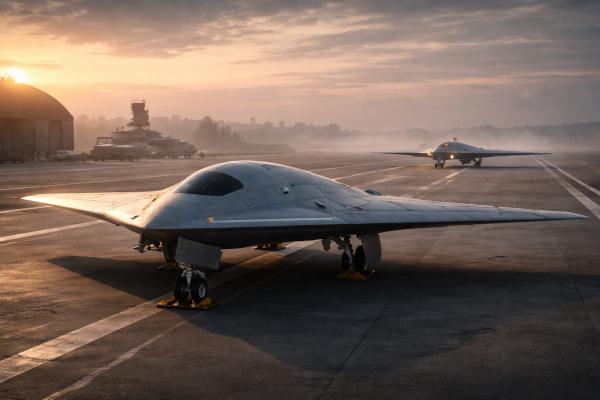
India’s Ghatak programme is one of the most important and least publicly detailed aerospace projects under development in the country: an indigenous stealth unmanned combat aerial vehicle (UCAV) intended to give India a deep-strike, low-observable, jet-powered unmanned platform for contested airspace. Although it is often described in public discourse as a future Indian Air Force asset, official responses have generally kept the description broader, linking it to the armed forces and withholding many specifics on grounds of national security. What is now clearly visible, however, is the technological path India has chosen: a tailless flying-wing stealth configuration, advanced autonomy, indigenous flight-control architecture, autonomous take-off and landing, and an eventual transition to a larger weapon-carrying combat platform powered by a derivative of the Kaveri engine family.
The roots of Ghatak go back to the older AURA concept—short for Autonomous Unmanned Research Aircraft—which emerged as India’s attempt to build a stealthy strike UCAV rather than just a surveillance drone. A 2016 Lok Sabha reply the Ministry of Defence stated that a proposal for the UCAV “Ghatak” programme and the development of a gas turbine engine for it had been submitted through official channels after review by a high-power committee chaired by the Principal Scientific Adviser.
The clearest public evidence of progress is not the full-sized Ghatak itself but the Stealth Wing Flying Testbed (SWiFT), also called the Autonomous Flying Wing Technology Demonstrator (AFTD). DRDO announced the successful maiden flight of this demonstrator in July 2022 from the Aeronautical Test Range, Chitradurga, stating that it flew in a fully autonomous mode and completed take-off, waypoint navigation, and touchdown successfully. In December 2023, DRDO and the Ministry of Defence announced another major milestone: a successful flight trial of the high-speed flying-wing UAV in tailless configuration, with officials stating that India had joined an “elite club” of countries to have mastered controls for a flying-wing aircraft in this configuration. That second announcement matters because tailless flying-wing control is one of the hardest parts of building a stealth UCAV.
Technically, the flying-wing choice is central to understanding Ghatak. A conventional aircraft uses a fuselage, tailplane, and vertical stabilizers to generate stability and control. A flying wing does away with much of that, blending lifting surfaces and fuselage-like volume into a single low-observable shape. The advantages are obvious for a UCAV meant to survive in defended airspace: fewer right-angle reflections, lower frontal and side radar returns, better internal volume for fuel and weapons, and cleaner shaping for radar cross-section reduction. The penalty is equally serious: without a conventional tail, stability and control become software-intensive problems, demanding precise aerodynamic modeling, advanced control laws, fast-acting actuators, high-integrity inertial and navigation systems, and robust flight-computer redundancy. The 2023 DRDO statement explicitly highlighted progress in robust aerodynamic and control systems, real-time simulation, hardware-in-loop simulation, and a modern ground control station.
One of the most technically significant features publicly disclosed is autonomous landing without dependence on ground radars or pilot intervention. According to DRDO, the December 2023 trial demonstrated landing using onboard sensor-data fusion combined with indigenous satellite-based augmentation through GAGAN receivers, allowing operation from any runway with surveyed coordinates. That may sound like a routine line in a press release, but it is not. For a combat UAV, this is a major operational enabler: it reduces dependency on elaborate fixed recovery infrastructure, improves survivability in dispersed operations, and moves the programme closer to true autonomous mission execution rather than remote piloting alone. In practical terms, this means Ghatak’s architecture is being shaped less like a radio-controlled drone and more like an autonomous combat aircraft with human mission supervision.
Open-source reporting on the SWiFT demonstrator, while not official specification release, is useful for understanding the scale of the test article. Reporting after the 2022 flight described SWiFT as roughly 4 metres long, with a 5-metre wingspan and an all-up weight of about 1 tonne, powered by a small imported turbofan identified in reporting as a TRDD-50MT-type engine. Those details fit the role of SWiFT as a technology demonstrator rather than an operational UCAV: it is large enough to meaningfully validate flight-control laws, autonomy, low-observable shaping, composite structures, and runway operations, but still much smaller and lower-risk than the eventual combat aircraft. Because these figures come from open-source reporting rather than a DRDO specification sheet, they are best read as informed estimates of the demonstrator, not confirmed dimensions of the final Ghatak.
The materials and structural approach are also revealing. Open-source descriptions tied to the 2023 trial noted the use of indigenous carbon-prepreg composite structures and embedded fiber interrogators for structural health monitoring. For a stealth UAV, composites do far more than save weight. They support smoother shaping, reduced panel discontinuities, lower corrosion burden, and better signature management than a purely metallic structure. Structural health monitoring, meanwhile, points to a programme trying to reduce test risk and lifecycle uncertainty early. In a tailless platform where loads, flutter margins, and control-surface interactions are especially sensitive, integrated monitoring is not a luxury; it is part of de-risking the vehicle as it moves from demonstrator to operational prototype.
The engine question is where Ghatak becomes strategically bigger than a single airframe. The intended long-term solution has long been a derivative of the Kaveri engine, often described in open sources as a dry, non-afterburning version for UCAV use. That makes engineering sense. A stealth UCAV does not necessarily need the same afterburning sprint profile as a manned fighter; what it needs is adequate subsonic thrust, better fuel efficiency, lower thermal signature, acceptable inlet-face management, and a propulsion package that integrates cleanly into a buried engine installation. Recent DRDO-linked material and DRDO-hosted reporting indicate that Kaveri and its derivatives remain active lines of work, and a DRDO-hosted clipping in early 2026 stated that the engine, producing about 51 kN, is being adapted for Ghatak. That specific statement comes via a hosted news clipping rather than a direct DRDO technical note, so it should be treated as a strong indicator rather than a formal programme specification. Even so, the overall direction is consistent across years of reporting: Ghatak’s success is inseparable from India’s aero-engine self-reliance effort.
That propulsion point matters because it defines what Ghatak can become. If powered by a dry Kaveri-class derivative in roughly the reported thrust band, the aircraft is likely being optimized not for supersonic dogfighting but for penetration strike, suppression/destruction of enemy air defences, ISR in contested zones, and stand-in attack roles. In that mission set, stealth, payload carriage inside the airframe, and endurance matter more than raw speed. A buried non-afterburning engine also simplifies thermal management relative to a hot afterburning fighter. The trade-off is that payload, acceleration, and mission radius will be tightly coupled to propulsion maturity, intake efficiency, internal fuel fraction, and flight-control drag management. This is why the Ghatak story is not just about autonomy or stealth; it is really about the convergence of airframe design, mission systems, and engine realism.
On the weapons side, official public releases do not disclose a certified payload suite, but the flying-wing stealth-UCAV layout strongly suggests an internal weapons bay approach if the aircraft is to preserve low observability. In Indian service logic, the most plausible future roles would include carriage of precision-guided munitions, potentially compact glide weapons, stand-off munitions, and anti-radiation or anti-surface weapons compatible with its bay geometry and thermal/RCS constraints. That is an inference, not an official loadout declaration. What can be said with confidence is that a stealth UCAV of this class would be operationally most valuable in the opening or highly contested phases of air operations: striking radar nodes, air-defence sites, command links, hardened targets, and mobile battlefield systems while exposing fewer aircrew to risk.
There is also a doctrinal reason Ghatak matters for the Indian Air Force even though the programme’s finer details remain undisclosed. Modern air combat is moving toward combinations of manned aircraft, loyal wingmen, autonomous scouts, stand-in jammers, and strike drones. India is already exploring this wider ecosystem through more than one programme, and official IAF indigenisation material has highlighted the importance of Manned-Unmanned Teaming (MUM-T) and the broader need for UCAVs. In that framework, Ghatak is not simply “a stealth drone.” It is potentially a node in a future combat architecture where unmanned systems absorb risk, extend sensor reach, degrade enemy defences, or strike first so that manned fighters can operate with lower attrition risk.
Still, the most important point in any serious assessment is to distinguish between what has been demonstrated, what has been officially acknowledged, and what remains undisclosed. Demonstrated: India has flown a jet-powered autonomous flying-wing technology demonstrator, including tailless configuration, and has shown autonomous runway operations. Officially acknowledged: the Ghatak UCAV programme has existed at government level for years, and Parliament has confirmed successful testing of the flying-wing demonstrator while declining to reveal sensitive programme details. Undisclosed: the final airframe size, operational range, payload capacity, radar cross-section targets, avionics architecture, sensor fit, datalink resilience, production timeline, and induction roadmap. That means any precise claims in public discussion about squadron numbers, exact tonnage, or firm induction dates should be treated cautiously unless they come from an official document.
The strategic significance of Ghatak, therefore, lies in what it represents for India’s aerospace base. Building a UCAV of this type is not a single-technology achievement. It requires competence in low-observable shaping, autonomous control, secure mission computing, composites, propulsion integration, embedded health monitoring, flight-test instrumentation, systems simulation, and weapons-bay-compatible airframe design. Even before the full-scale aircraft appears publicly, the SWiFT/AFTD work shows India is solving some of the hardest foundational problems in sequence. If the programme sustains momentum and the engine side matures as intended, Ghatak could become India’s first genuinely indigenous stealth strike UAV—less a replacement for manned fighters than a new class of aircraft for the most dangerous first-wave missions.
Reference:
https://www.pib.gov.in/Pressreleaseshare.aspx?PRID=1838507
https://www.pib.gov.in/PressReleasePage.aspx?PRID=1986788
https://www.mod.gov.in/en/node/93047
https://sansad.in/getFile/loksabhaquestions/annex/7/AU1607.pdf?source=pqals
https://indianairforce.nic.in/Resources/pdf/indigenisation/IAF-COMPENDIUM-ON-INTERNET-WEBSITE.pdf
ADDITIONAL GOVERNMENT / OFFICIAL CONTEXT
https://eparlib.sansad.in/bitstream/123456789/65200/1/16_Defence_9.pdf
SUPPORTING OPEN-SOURCE REFERENCE
https://en.wikipedia.org/wiki/DRDO_Ghatak
You may also like
-
India’s Indigenous Sonar Ecosystem Powers New Generation of Indian Navy Warships
-
Murshidabad Becomes First West Bengal District to Complete Land Handover for India-Bangladesh Border Fencing
-
India’s LR-AShM Family Could Reach 3,500 Km as DRDO Develops Extended-Range Hypersonic Variants
-
Indian Composite Manufacturing Gets BrahMos Boost With ₹60-Crore Order to Allen Reinforced Plastics
-
HAL-Samtel Opens New Gurugram Facility to Expand Indigenous Defence Avionics and Display Manufacturing
