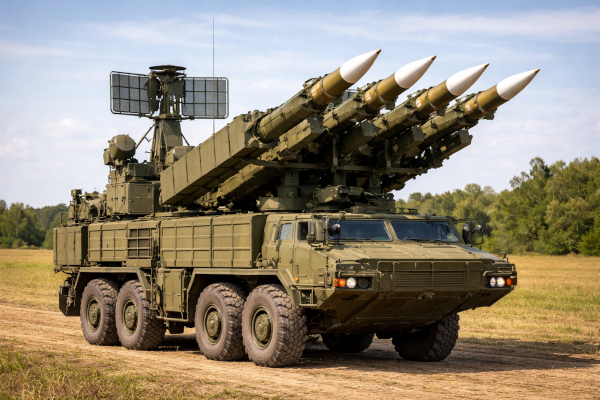
In modern air warfare, the systems that get the most attention are usually the glamorous ones—the long-range interceptors, the hypersonic headlines, the strategic shields that dominate television graphics. But real air defence is rarely won by glamour alone. It is won by layers, reaction time, survivability, and the ability to kill the threat that gets in low and late. That is where the OSA-AK belongs.It is one of those battlefield assets that makes layered defence credible. In the public narrative that emerged after Operation Sindoor, India explicitly listed OSA-AK alongside Pechora and LLAD guns as part of the battle-proven air-defence architecture used during the operation, while also highlighting the performance of indigenous systems such as Akash. That alone tells us something important: OSA-AK remained part of India’s active defensive web during a live military crisis.
That matters because Operation Sindoor was publicly framed as an example of layered, networked, integrated air defence. Official releases said that on the night of 7–8 May 2025, Pakistan attempted to engage military targets across northern and western India using drones and missiles, and that these attacks were neutralised by India’s Integrated Counter-UAS Grid and Air Defence systems. In the same official account, the government described multiple defensive layers extending inward from the international border—counter-UAS systems, shoulder-fired weapons, older air-defence weapons, and modern air-defence systems. OSA-AK fits naturally into that middle ground: a practical, mobile, short-range missile system designed to catch what penetrates the outer shield and threatens forces or assets closer to the tactical edge.
Technically, the OSA-AK is a Soviet-origin short-range, low-altitude tactical surface-to-air missile system from the 9K33 Osa family, known in NATO reporting as the SA-8 Gecko. Its core design logic was unusually advanced for its time: it combined its radar suite, fire-control functions, and missile launch capability on a single wheeled TELAR vehicle (Transporter Erector Launcher and Radar) rather than splitting those functions across separate launchers and radars. That gave it autonomy and mobility, allowing a single combat vehicle to detect, track and engage aerial threats with minimal dependence on a larger fixed-site architecture. Trade and technical references describe the system as carrying six 9M33-series missiles on later variants, using onboard surveillance and engagement radars, and operating from an amphibious 6×6 BAZ-5937 chassis with high road mobility and a range of roughly 500 km.
Let us look at the technical core of the system in more specialist terms. The OSA-AK is a self-propelled, all-weather, command-guided short-range SAM system designed for low-altitude point and area defence of maneuver formations. It integrates search and tracking radars on the same launcher vehicle, enabling rapid target acquisition and engagement without waiting for an external fire-control chain. Later variants are typically associated with 9M33M2 or 9M33M3 missiles, with engagement ranges broadly in the 10–15 km class depending on missile variant and target profile, and altitude coverage extending from very low level to several kilometers above the battlefield. The system’s combat value lies in its ability to prosecute fast, low-flying aircraft, helicopters, and increasingly drone-class threats inside the short-range envelope where terrain masking and reaction time become decisive. Because it is ground-command guided, the missile depends on the vehicle’s radar and control logic rather than an onboard active seeker, which reduces missile complexity but places a premium on radar performance, crew proficiency, and resistance to electronic interference.
That technical architecture explains why OSA-AK has endured. It is a tactical air-defence weapon, built to move with forces, protect vulnerable points, and react quickly to sudden low-level threats. In Indian service, its relevance lies precisely there. India’s broader air-defence network now includes far more modern and more indigenous elements, but a layered defence grid still benefits from systems that can provide close-in, mobile, fast-reaction coverage. Independent analyses of India’s 2025 air-defence posture described OSA-AK as part of the country’s legacy Soviet-origin short-range layer, complementing more advanced systems rather than replacing them. That is the correct way to understand it as part of the practical architecture.
There is also a larger doctrinal lesson here. The drone age has forced militaries to rethink the economics of air defence, because not every incoming target justifies the expenditure of a premium interceptor. A layered grid works precisely because it allows commanders to match the right effector to the right threat: some drones are jammed, some are brought down by guns, some require missiles, and some must be intercepted early before they can swarm or saturate a defended sector. Recent fighting between the United States and Iran illustrated this cost dilemma brutally. CSIS estimated that the first 100 hours of the campaign cost about $3.7 billion, with air-defence munitions forming a major share of that burden, while Reuters noted the stark asymmetry involved in firing $4 million Patriot interceptors and $13–15.5 million THAAD interceptors against Iranian Shahed drones often estimated at just $20,000 to $50,000 each. That is exactly why systems like OSA-AK continue to matter. They occupy the short-range engagement space where inexpensive but dangerous aerial threats often appear, allowing a military to avoid wasting its most expensive interceptors on every low-cost target that enters the battlespace. When official Indian statements on Operation Sindoor explicitly grouped OSA-AK with both legacy and modern air-defence layers, they were effectively acknowledging the enduring value of this kind of system-of-systems defence, where the objective is not merely to shoot everything down, but to do so intelligently, sustainably, and at a cost ratio a defender can survive.
On the industrial side, OSA-AK is not an indigenous Indian missile system; it is foreign in origin. But India’s current approach to such platforms is increasingly about domestic sustainment, subsystem replacement, and selective modernisation rather than passive dependence on the original supplier. One visible example is the indigenously developed trailer-mounted alignment system for OSA-AK described by Pinaka as a replacement for an ageing OEM-supplied alignment system, using indigenous RF and hydro-mechanical subsystems. In parallel, a 2025 GeM procurement document referred to the upgradation of OSA-AK combat vehicles, indicating that India is still investing in keeping this short-range air-defence layer operational. It does show how India is trying to localise support functions around legacy foreign-origin platforms.
So the real significance of OSA-AK is in utility. In an era when the sky is increasingly crowded by drones, cruise-type profiles, and low-level precision threats, India cannot afford an air-defence architecture made only of exquisite systems and expensive interceptors. It needs layers that are dense, mobile, and available. OSA-AK survives in that logic. Operation Sindoor appears to have underlined exactly why such systems still matter: because wars are not fought in brochures. They are fought in the narrow engagement windows where reaction time, coverage, and battle-tested reliability decide whether an incoming threat becomes a headline—or debris.
Reference:
PIB: Operation SINDOOR: The Rise of Aatmanirbhar Innovation in National Security
https://www.pib.gov.in/PressReleasePage.aspx?PRID=2128746
PIB: Operation SINDOOR: Forging One Force
https://www.pib.gov.in/PressReleasePage.aspx?PRID=2129453
Army Technology: 9K33 Osa Air Defence Missile System, Russia
https://www.army-technology.com/projects/9k33-osa-air-defence-missile-system-russia/
Army Recognition: SA-8 Gecko 9K33 OSA
https://www.armyrecognition.com/military-products/army/air-defense-systems/air-defense-vehicles/sa-8-gecko-russia-uk
ORF: Air Defence Mechanisms: A Primer on India and Pakistan
https://www.orfonline.org/research/air-defence-mechanisms-a-primer-on-india-and-pakistan
Pinaka: Make in India
https://www.pinaka.co.in/make-in-india.aspx
You may also like
-
India Moves Towards Five-Year Assured Orders for Defence Startups Under New Procurement Reforms
-
Zen Technologies Introduces Indigenous Hyper-Strike Falcon AI-Guided Counter-Drone Interceptor
-
L&T and Germany’s SCHOTTEL Expand Partnership for Controllable Pitch Propeller Systems in Indian Shipbuilding
-
India to Train 60,000 Civil Defence Volunteers Across 12 States and UTs with Indian Army Support
-
Indian Army’s Northern Command Opens 75-Day Defence Technology Internship Programme for Young Innovators
