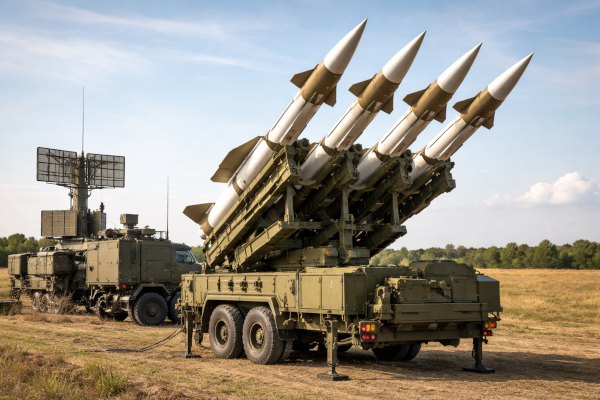
There is something almost poetic about the Pechora. It is this Soviet-origin air-defence system from another era, a veteran of analog warfare in a world now obsessed with drones, electronic warfare, loitering munitions and networked battle grids. And yet, in the months after Operation Sindoor, Pechora has returned to the centre of India’s air-defence conversation for one simple reason: when the sky gets crowded with real threats, reliability matters more than fashion. Bharath’s own public messaging around Operation Sindoor placed Pechora among the battle-proven air-defence systems used alongside OSA-AK and low-level air-defence guns, while also highlighting the stellar performance of indigenous systems such as Akash. The same official note stressed that Pakistan’s drone and missile attempts against multiple military targets on the night of 7–8 May 2025 were neutralised by the Integrated Counter-UAS(Unmanned Aerial System) grid and Indian air-defence systems.
First, Operation Sindoor was not the triumph of any one missile battery. It was presented as a layered defence effort in which legacy systems, indigenous systems, radars, control centres and networked command structures worked together. Second, Pechora was not missing from that story. It was named. In media reporting during the May 2025 escalation, the Indian Air Force publicly stated that it had used “CUAS, PECHORA, SAMAR and AD guns,” presenting Pechora as an active part of the defensive umbrella during Pakistani drone incursions. Even allowing for the fog that surrounds active operations, the public picture is clear enough: Pechora was operationally relevant during a live crisis.
To understand why that is significant, one has to understand what Pechora actually is. Internationally known as the S-125 Neva/Pechora, it is a Soviet-origin surface-to-air missile system designed to engage low- to medium-altitude aerial threats. In Indian service, it has been around since the 1970s and has therefore spent decades forming part of the country’s air-defence backbone. That longevity is not accidental. Systems like Pechora survive because air defence is about maintaining enough layers, enough shooters, and enough geographical spread to complicate an adversary’s attack plan. The Pechora, known in its original Soviet designation as the S-125 Neva/Pechora, is a low-to-medium altitude surface-to-air missile system built to engage targets that slip beneath the engagement envelope of heavier strategic air-defence assets. Technically, it is a ground-controlled, radar-command-guided SAM system: the target is acquired by surveillance radar, handed over to the fire-control radar, and the missile is then guided in flight through command signals transmitted from the ground rather than by an onboard active seeker. The system traditionally works with two-stage solid-fuel missiles of the 5V24/5V27 family, capable of high supersonic interception, and is paired with radar elements such as the P-15 target acquisition radar and the SNR-125 “Low Blow” tracking and guidance radar. Its enduring value lies in its ability to prosecute low-flying, manoeuvring targets with better low-altitude coverage than earlier Soviet-era systems, which is precisely why it has retained operational relevance in layered air-defence networks.
But the most interesting part of the Pechora story is not that India kept an old missile. It is that India refused to leave it old. In January 2026, The Times of India reported that Bengaluru-based Alpha Design Technologies Ltd. had completed a major upgrade of the Indian Air Force’s Pechora system, fully digitising it and positioning it to strengthen India’s air-defence posture. The report described this as a major indigenous modernisation of ageing military hardware. Another report noted that the company had become, in its own telling, the first Indian private firm to modernise a vintage Russian-origin weapon system and successfully carry out surface-to-air missile launches as part of that effort. This is where the Pechora story stops being merely about legacy and becomes a story about Indian adaptation.
And this is where the Make in India component deserves real emphasis. Pechora itself is not Indian in origin. No serious defence article should pretend otherwise. It is a Russian/Soviet design that India inducted decades ago. But the current chapter of its life is unmistakably Indian in execution. According to reporting on the programme, Alpha Design signed a roughly ₹591 crore contract in September 2020 to upgrade and digitise 16 Pechora missile and radar systems. The upgrade involved full digitisation and the indigenous manufacture and supply of key subsystems such as thermal imaging fire-control units, software-defined radios, handheld laser target designators and missile launch detection systems. It means India is no longer merely operating an imported legacy platform; it is learning how to rebuild, extend, digitise and network it through domestic industry.
In defence terms, that distinction is crucial. Make in India is often mistaken as if it begins only when a weapon is designed from scratch in India. In reality, military self-reliance grows in layers. One layer is original design. Another is licensed production. Another is maintenance, overhaul, digitisation and life-extension of imported systems using Indian engineering, Indian supply chains and Indian private-sector capability. The Pechora programme sits squarely in that third category, and that is why it is more important than it may first appear. It demonstrates that Indian industry can take a legacy foreign-origin system and push it toward contemporary standards of usability and survivability rather than waiting helplessly for foreign OEM support or prematurely discarding a still-useful asset.
Operation Sindoor, in that sense, may prove to be the moment that clarified the value of this approach. The official government narrative on the operation repeatedly stressed technological self-reliance, integrated air defence, and the role of indigenous systems in layered protection. It also described the Integrated Air Command and Control System as the net-centric structure that tied these elements together in combat. Seen through that lens, the future of Pechora in India is not as a solitary old launcher standing in nostalgic isolation. Its future lies in being plugged into a wider, smarter, more connected defensive web. The weapon may be old in origin, but its battlefield relevance now depends on how well India can digitise, network and maintain it inside a larger command-and-control architecture.
There is also a larger doctrinal message here. Recent wars have exposed a brutal truth: not every threat deserves, or economically justifies, the launch of an expensive top-tier interceptor. Drones, low-cost munitions and saturation attacks can force even advanced militaries into bad cost equations. That is why an upgraded Pechora still matters. It belongs to the grammar of layered defence, where older but viable systems absorb part of the burden, protect specific assets, and ensure that high-end interceptors are not wasted on every incoming target. Operation Sindoor seems to have reinforced exactly this logic. Pakistan’s attacks, according to official releases, involved missiles, drones, rockets and electronic warfare. India’s response was to rely on a broad, integrated defensive shield rather than a single silver bullet. Pechora’s continued presence in that shield says a great deal about the kind of war Indian planners believe they may have to fight again.
So Pechora’s story in India is no longer the story of an antique kept alive out of habit. It is the story of a veteran system reworked for a new age. Operation Sindoor gave it much needed relevance. Indian industry gave it a second life. And the deeper lesson is one India’s defence ecosystem is learning with increasing confidence: self-reliance does not always begin with building something entirely new. Sometimes it begins with taking what you already have without reinventing the wheel, understanding it better than anyone else, and making it fight again on your own terms. Pechora, after Sindoor, stands as exactly that kind of lesson—old steel, new circuitry, and a very Indian answer to the pressure of modern war.
Refernce:
PIB: Operation SINDOOR: The Rise of Aatmanirbhar Innovation in National Security
https://www.pib.gov.in/PressReleasePage.aspx?PRID=2128746PIB: Operation SINDOOR: Forging One Force
https://www.pib.gov.in/PressReleasePage.aspx?PRID=2129453PIB: Ministry of Defence Year End Review 2025
https://www.pib.gov.in/PressReleasePage.aspx?PRID=2210154India Today: How India foiled Pak's attack, turned its missiles, drones into debris
https://www.indiatoday.in/india/story/india-foiled-pakistan-missile-drone-attack-night-awantipora-bhuj-rajasthan-integrated-counter-uas-grid-air-defence-2721593-2025-05-08Army Technology: 9K33 Osa Air Defence Missile System, Russia
https://www.army-technology.com/projects/9k33-osa-air-defence-missile-system-russia/Wikipedia: 9K33 Osa
https://en.wikipedia.org/wiki/9K33_Osa
You may also like
-
India Moves Towards Five-Year Assured Orders for Defence Startups Under New Procurement Reforms
-
Zen Technologies Introduces Indigenous Hyper-Strike Falcon AI-Guided Counter-Drone Interceptor
-
L&T and Germany’s SCHOTTEL Expand Partnership for Controllable Pitch Propeller Systems in Indian Shipbuilding
-
India to Train 60,000 Civil Defence Volunteers Across 12 States and UTs with Indian Army Support
-
Indian Army’s Northern Command Opens 75-Day Defence Technology Internship Programme for Young Innovators
