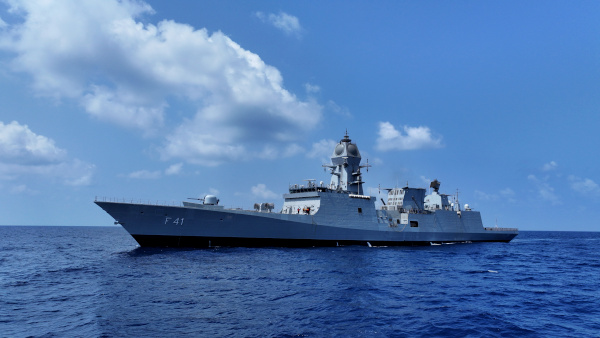
The Indian Navy is set to commission its latest stealth frigate, Taragiri (F41), at Visakhapatnam on April 3, 2026, in a ceremony expected to be presided over by Defence Minister Rajnath Singh. The warship is a major addition to India’s frontline naval capability and represents another important milestone in the country’s long push toward self-reliance in defence manufacturing. Taragiri is the fourth ship of the Nilgiri-class under Project 17A and the third of the class to be built by Mazagon Dock Shipbuilders Limited (MDL), Mumbai, under an ambitious indigenous warship construction programme designed to upgrade the Navy’s surface combat fleet with more advanced stealth, automation and firepower.
With a displacement of about 6,670 tonnes, a length of 149.02 metres, and a beam of 17.8 metres, Taragiri is one of the most sophisticated frigates built in India to date. It has been designed by the Indian Navy’s in-house warship design establishment and constructed using the Integrated Construction methodology, under which hull blocks are built in different locations and then assembled at the shipyard. The keel of Taragiri was laid on September 10, 2020, it was launched on September 11, 2022, and was delivered to the Indian Navy on November 28, 2025. Official statements say its build period was compressed to 81 months, compared to 93 months for the first ship of the class, reflecting gains in design maturity, production efficiency and shipyard execution.
Taragiri is built around a Combined Diesel or Gas (CODOG) propulsion system, using two gas turbines and two main diesel engines, a configuration intended to give the ship both high-speed dash capability and endurance during long deployments. According to official information, the frigate is designed to achieve a speed of over 28 knots. The class also incorporates a Controllable Pitch Propeller (CPP) arrangement on each shaft and an Integrated Platform Management System (IPMS) to improve control, monitoring and survivability in combat situations. These features make the ship suitable for a wide spectrum of maritime tasks, from conventional naval warfare to patrol, escort, and strategic presence missions across the Indian Ocean region.
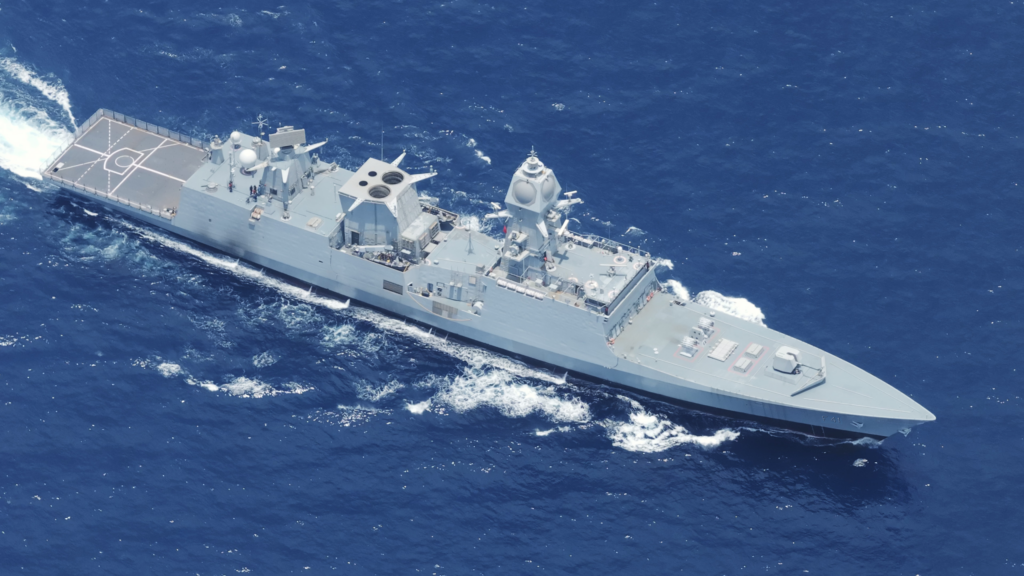
The frigate’s combat package is built for multi-dimensional warfare. Official descriptions state that Taragiri is equipped with BrahMos surface-to-surface missiles, the MF-STAR radar, and the MRSAM air-defence complex, along with a 76 mm Super Rapid Gun Mount, 30 mm and 12.7 mm close-in weapon systems, as well as rockets and torpedoes for anti-submarine warfare. Earlier official material on the ship also noted that it is fitted with a supersonic surface-to-surface missile system, long-range surface-to-air missile capability, rapid-fire guns for close defence, and indigenously developed triple-tube lightweight torpedo launchers. Together, these systems are meant to allow Taragiri to deal with threats in the air, on the surface, and underwater, giving it true multirole capability as a frontline guided-missile frigate.
A major part of Taragiri’s strategic value lies in its indigenous content. The frigate has an indigenisation level of about 75 percent, an important benchmark in India’s effort to reduce dependence on imported defence platforms and sub-systems. According to official releases, the Project 17A programme has involved more than 200 MSMEs, while the construction of Taragiri alone is linked to employment generation for approximately 4,000 personnel directly and more than 10,000 indirectly. Earlier official communication had described integration with equipment and machinery sourced from major Indian industrial houses as well as over 100 MSMEs, while the later delivery statement reflected the broader industrial ecosystem that has now grown around the class. That scale of domestic participation makes Taragiri not just a warship, but also a symbol of how India’s defence manufacturing base is becoming deeper, broader and more technically confident.
Taragiri also carries historical weight. It revives the name of the earlier INS Taragiri, a Leander-class frigate that served the Indian Navy from May 16, 1980, to June 27, 2013, completing 33 years of service. The new Taragiri is presented by the Navy as a modern reincarnation of that legacy, but with a far more advanced design focused on stealth, survivability, automation and networked combat. Officials have described the ship as a “quantum leap” over the earlier Shivalik-class (Project 17) frigates, especially in terms of reduced radar signature, upgraded sensors, more advanced weapons integration and improved combat management capability.
The commissioning of Taragiri is part of a larger momentum in Indian naval induction. Official data shows it is the fourth Project 17A ship delivered to the Navy in the last 11 months, and the remaining three ships of the programme — one at MDL and two at Garden Reach Shipbuilders & Engineers (GRSE) — are planned for progressive delivery by August 2026. That timeline matters because Project 17A is one of the Indian Navy’s most important surface fleet modernisation programmes, intended to build a new generation of stealth frigates capable of handling both present and emerging maritime challenges.
Beyond combat, Taragiri has also been projected as a platform suited for Humanitarian Assistance and Disaster Relief (HADR), maritime diplomacy and sustained peacetime deployments. That broader role reflects the Indian Navy’s expanding mission set in the Indo-Pacific, where warships are increasingly expected to serve as instruments not just of deterrence, but also of regional reassurance, evacuation support, anti-piracy operations and disaster response. In that sense, Taragiri is not simply another addition to the fleet; it is a statement about India’s intent to field ships that are Indian-designed, Indian-built and capable of operating across the full spectrum of naval missions.
Reference:
You may also like
-
India’s Indigenous Sonar Ecosystem Powers New Generation of Indian Navy Warships
-
Murshidabad Becomes First West Bengal District to Complete Land Handover for India-Bangladesh Border Fencing
-
India’s LR-AShM Family Could Reach 3,500 Km as DRDO Develops Extended-Range Hypersonic Variants
-
Indian Composite Manufacturing Gets BrahMos Boost With ₹60-Crore Order to Allen Reinforced Plastics
-
HAL-Samtel Opens New Gurugram Facility to Expand Indigenous Defence Avionics and Display Manufacturing
