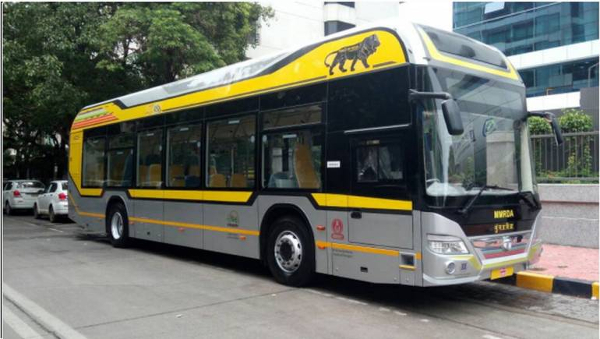
The Union Cabinet, chaired by the Prime Minister Shri Narendra Modi, has approved the “PM-eBus Sewa-Payment Security Mechanism (PSM) scheme” for procurement and operation of e-buses by Public Transport Authorities (PTAs) with an outlay of Rs. 3,435.33 crore.
This scheme will support deployment of more than 38,000 electric buses (e-Buses) from FY 2024-25 to FY 2028-29. The scheme will support the operation of e-buses for a period of up to 12 years from the date of deployment.
At present, the majority of buses operated by Public Transport Authorities (PTAs) run on diesel/CNG, causing adverse environmental impact. On the other hand, e-buses are environment friendly and have lower operational cost. However, it was anticipated that Public Transport Authorities (PTAs) would find it challenging to procure and operate e-buses because of their high upfront cost and lower realization of revenue from operations.
To address the high capital cost of e-buses, Public Transport Authorities (PTAs) induct these buses through Public Private Partnership on Gross Cost Contract (GCC) model. The PTAs are not required to pay the upfront cost of the bus under the GCC model, instead OEMs/operators procure and operate e-buses for PTAs with monthly payments. However, OEMs/operators are hesitant to engage in this model due to concerns about potential payment defaults.
The scheme addresses this concern by ensuring timely payments to OEMs/operators through a dedicated fund. In case of default of payments by PTAs, CESL, the implementing agency, shall make necessary payments from the scheme funds which will be later recouped by the PTAs/State/UTs.
This initiative seeks to facilitate adoption of e-buses by encouraging private sector participation. The scheme will also lead to significant reductions in greenhouse gas emissions and also reduce the consumption of fossil fuel. The scheme will provide benefits to all Public Transport Authorities (PTAs) present in State/UTs who opt for the scheme.
You may also like
-
Sanchar Saathi Helps Recover Record 75,000 Lost and Stolen Mobile Phones in a Single Month
-
India Recognises Heatwaves and Lightning as Notified Calamities, Expands Disaster Relief Framework to 14 Hazards
-
India Deepens Green Diplomacy With Bhutan and Sri Lanka at UNCCD COP17 in Mongolia
-
India Restored 21.76 Million Hectares of Land, Generated 1.22 Billion Person-Days of Employment During 2011–2020
-
India’s Livestock Disease-Control Drive Cuts FMD and Brucellosis Outbreaks
