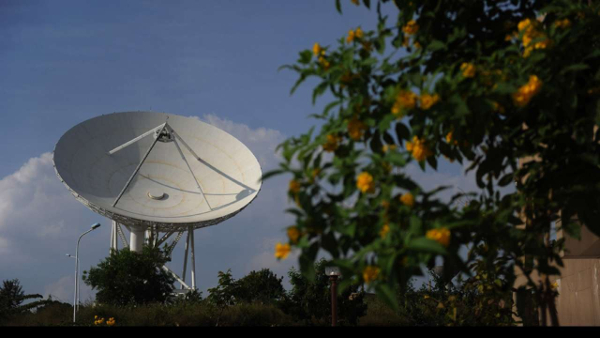
MUMBAI: For the past one week Isro has been trying to “talk” to Chandrayaan-2’s Vikram lander which stopped communicating when it was about to execute a soft landing in the south pole region of the moon in the early hours of September 7. Not many are aware that Barc at Trombay has a role in helping Isro to establish this connection with the lander.
And how? An antenna of 32-metre diameter, jointly developed by Bhabha Atomic Reserch Centre (Barc) and the Electronics Corporation of India (Ecil), which is part of the Indian Deep Space Network at Byalalu near Bengalaru, is playing a role to establish this much-awaited link, along with Nasa’s Deep Space Networks at Goldstone in California, Madrid in Spain and Canberra in Australia. Ecil is a part of the department of atomic energy.
According to a spokesperson of Barc, the 32-metre antenna, about five times the size of a tennis court, costs Rs. 65 crore. He said the same antenna was also used for India’s first lunar mission, Chandrayaan-1, and the Mars Orbiter Mission.“If the flawless launch of Chandrayaan-2 is a tribute to Isro scientists, the 250-tonne, antenna of 32-metre diameter is a testimony to the skill of Barc and Ecil.” said the spokesperson.
Chandrayaan-2 was launched on July 22. He said that it provides a two-way radio communication with the spacecraft. It receives signals from the spacecraft and transmits commands from the spacecraft control centre to the spacecraft.
Space officials told TOI that in the present case the two-way communication is with Chandrayaan-2’s orbiter which is operating, and one-way from the control centre to the lander.
Source: ToI
Image Courtesy: DNA India
You may also like
-
India’s Renewable Energy Capacity Expands as Solar Power Reaches 175 GW and Wind Power Crosses 59 GW
-
India Advances ₹68,816 Crore Ultra-High-Voltage Transmission Corridor to Strengthen National Power Grid
-
PM Modi Inaugurates India’s First LED Dome Planetarium at Mysuru
-
Ashoka Buildcon Secures $58.9 Million Contract to Develop 120 MW Solar Power Plant in Bhutan
-
Tata Power to Begin Construction of 10 GW Solar Ingot and Wafer Manufacturing Plant in Odisha
